Category: Marketing

  • Inbound Marketing: Tips & Tactics for 2021

    Inbound Marketing: Tips & Tactics for 2021

    Are you looking to improve your inbound marketing strategy but aren’t quite sure how to do it? 

    Inbound marketing is a great way to grow your traffic without having to spend money on paid ads. If you tackle inbound marketing the right way, you’ll be able to create evergreen content that attracts more customers over time. 

    What do you need to do to create a great inbound marketing strategy for 2021? 

    Check out this guide to discover the top inbound marketing tips and tactics for the coming year. 

    What is Inbound Marketing? 

    Before the internet, businesses had to take out ads in newspapers and on billboards to get the word out about their business. Times have changed drastically, and now, businesses can attract customers to their products and services without the use of paid advertisements. 

    This, essentially, is what inbound marketing is. Inbound marketing is the process in which businesses organically attract people to their website. Inbound marketing also involves building relationships with customers by providing them with help, education, and value. 

    Inbound marketing relies on a variety of strategies and tactics to function, including content marketing, lead generation, chatbots, SEO, and web design. 

    The great thing about inbound marketing is that it’s more affordable than outbound marketing, and it allows you to build more meaningful relationships with your clients. However, inbound marketing is a bit more time-consuming and competitive. It can also be harder to track. 

    This is why you need inbound marketing tactics in place before you get started so you can outsmart the competition and see quicker results. Let’s dive into the strategies you need to use next. 

    1. Do Your Research 

    Before you make any adjustments to your inbound marketing strategy, you first need to do some research. You need to make sure you understand three things: your industry, your business, and your customers. 

    Take some time to review your KPIs and metrics to gain a better understanding of the inbound marketing goals you’re trying to reach. Then, think about how you’re going to get there by looking at your conversion processes and ensuring they align with your overall strategy and metrics. 

    Next, take a look at your overall industry by studying your competitors. Then, do some research on your customers by looking into their pain points and what problems they have that you need to solve. 

    2. Develop a Strong Content Strategy 

    A strong content strategy is the foundation of a solid inbound marketing strategy. To define your content strategy, start by asking yourself these questions:

    • What type of content does my audience best respond to? Do they prefer blogs, white papers, infographics, or videos?
    • What platform does the best job at attracting customers? Is it Facebook, Instagram, Youtube, etc.? 
    • How much content can we consistently produce each week?

    By answering these questions, you’ll be able to set the framework for your content strategy. 

    3. Create Great Content 

    Once you have a content strategy in place, it’s time to start creating great content. You should offer your consumers a mix of regular content and premium content

    Regular content is content that can be accessed via your website and social media channels. Premium content, on the other hand, is content that’s exclusive to a select group of people. People will usually be happy to hand over their email addresses for access to quality premium content. 

    Your regular content and premium content should be a blend of funny, entertaining, informative, and inspiring. You also want to mix in some live and animated content with written content. 

    When creating content for your business, make sure to keep your overall objectives and content strategy in mind. 

    4. Master Technical SEO 

    Technical SEO is another major component of inbound marketing. Technical SEO involves analyzing how your site is performing on Google (or whatever search engine you’re using to drive the most traffic). 

    At least once a month, your company should run a site audit to ensure that your site is performing well and doesn’t have any outstanding issues. You can use a tool like SEMrush or Google Search console to conduct your site audits. 

    By tracking your technical SEO stats, you’ll be able to find ways to boost your results in the search engines. 

    5. Create Segmented Emails 

    People respond well to targeted emails. By segmenting your audience, you’ll be able to create more personalized emails that capture their attention. 

    You can segment your email audience by:

    • Purchase history
    • Demographics
    • Web activity
    • Open rates
    • Click-through rates

    By personalizing the emails you send your customers, you’ll be able to connect with them on a deeper level. This can help you increase your odds of turning one-time purchasers into loyal customers. 

    6. Revamp Your Website Layout 

    Users have very high expectations when it comes to websites. If your website layout isn’t clear, visually appealing, and intuitive, then you’re going to lose a lot of potential customers. 

    Even if you have the best inbound marketing strategies on the planet, they won’t mean anything if you’re sending leads to a site that doesn’t look good. Have someone take an objective look at your website to figure out where you need to make improvements. 

    Are You Ready to Step Up Your Inbound Marketing?

    Now that you’ve read this guide, it’s time for you to put these inbound marketing tips and tactics to use. With these tips, your business will be able to reach new heights in 2021. 

    If you’re looking for more help with your inbound marketing strategy, click here to learn how HyperTarget Marketing can help you. 

  • Cold Transfer vs. Warm Transfer Calls: A Call Marketing Guide

    Cold Transfer vs. Warm Transfer Calls: A Call Marketing Guide

    cold transfer vs warm transfer

    Keeping customers happy requires catering to their every need— all the way down to how your business answers phone calls. According to studies, a customer is four times more likely to purchase products from a competitor if they dislike the customer service at a particular company.

    Most people can agree that some of the main things that customers hate are rude representatives, long hold times, and being transferred from one department to the other. The best way to cut down on this type of headache is by implementing warm transfers.

    However, if your company is new to this concept, this guide has you covered. We’ll explain the difference between a cold transfer vs warm transfer, and its benefits. Keep reading to learn more.

    Cold Transfer vs Warm Transfer

    A very common feature for today’s telecommunications is transferring calls. Basically, it’s the capability to switch a call from one person to another.

    There are two ways in which a call transfers: cold (blind) and warm (attended). Essentially, the key distinction is whether or not the call is initiated or announced before the switch is actually made. 

    The distinction is primarily the contrast between a warm invite and a cold shoulder. The warm transfer option requires an introduction along with some basic background information. It also includes a friendly reminder that the call is getting transferred.   

    When no discussion or prior information is required, the cold transfer option is a quick and simple substitute. It’s called a cold/blind transfer because the call gets transferred without knowing if the other party is available to speak to the caller.

    Are Warm Transfer Calls Better?

    One of the most unpopular features of the modern call center is the traditional cold transfer. It’s the procedure of transferring an individual without filtering the call to determine the identity of the caller and the reason for the call. 

    Why would a company want to stay away from cold transfers?  Well, they make customers have to repeat themselves over and over again each time they are transferred to a different representative. This is exhausting, irritating, and time-consuming—especially when they have a difficult issue or a complicated concern.

    Warm transfers involve the gathering of pertinent information to ensure that the call is transferred to the correct person or department. Even if it’s just the caller’s name and the purpose of the call, getting information first helps to ensure that the transaction is handled correctly.

    This type of transfer dramatically increases call traffic flow, decreases average wait times, and substantially enhances the experience of customers.

    The Benefits of Warm Transfer Calls for Your Business

    When it comes to the contrast between a cold transfer vs warm transfer, the warm transfer option is the winner. What does a warm transfer in a call center do for your company? Other than preventing customers from being tossed from one line to the next?

    Well, it sends a direct message to your callers that your focus is on them. This is the most critical component of warm transfers. The way your business handles calls shows customers whether or not your company is taking their concerns seriously.   

    Sometimes, as corporations expand, they seem to lose sight of the intimate connections that make customers feel loved and appreciated. At least, that’s the impression most customers will get when they’re not treated nicely over the phone.

    A successful company never forgets the value of treating customers with care. Even if it’s something as simple as a warm transfer.

    Helping Your Employees Understand the Value in Warm Transfer

    If your call center has primarily used cold transfers in the past, that’s okay. You can train your staff on how to conduct warm transfers. Preparing your representatives to execute warm transfers is one of the first phases of ensuring that they’re done properly.

    Do the members of your customer contact team know how to direct calls the right way? Do they understand the necessary “small talk” needed to prevent the uncomfortable silence that makes a phone call awkward before a transfer? 

    Luckily, all of these things can be taught and discussed in call center training before the representatives ever make their first warm transfer.

     A crucial point to bear in mind is that today’s callers have limited attention spans and high demands for timely and proficient customer service. This is especially true for the Millenials being served in the market.

    It’s better to answer the phone and occupy them than to keep them hanging on the line. Teach your reps how to provide constant engagement to every customer.

    Essentially, when it comes to cold transfer vs warm transfer, cold transfers should never be an option. There may be certain circumstances where they’re needed, but it’s rare. When a person calls into your company, the goal should always be to help them as much as possible.

    This is definitely true if your business has a call center. Be sure to implement protocols that ensure that no customer is confused about what’s happening on a call.

    Get the Most Out of Warm Transfer Calls

    When it comes to a cold transfer vs warm transfer, you can never go wrong with warm transfer calls. It’s one of the best ways to ensure that your customers are happy and that their experience with your company is great.

    Speaking of phone calls, does your business need assistance? If so, HyperTarget marketing is here to help. We provide warm transfers, lead generation services, and more. 

    If you’re interested in getting started, call us at 213-973-9905 or contact us online for more information.

    We look forward to talking with you soon.

  • Savvy Marketers Shouldn’t Miss The Hottest Inbound Marketing Trends for 2019

    Savvy Marketers Shouldn’t Miss The Hottest Inbound Marketing Trends for 2019

    marketing trends

    Your content creator needs a day off. You probably can’t afford to give them one, since they have so much to do – but we bet they’re exhausted.

    Why? Because marketing trends in 2018 were all about quality and authenticity, which was a big change from the CONSTANT CONTENT!! push of 2017.

    Next year, 2019, will see the refinement of 2018 techniques. Videos will still hold importance, but they’d better be well thought out. Learn other marketing trends we’re predicting for 2019 below.

    Fewer Facebook Ads

    What we’re about to say might scare you. In 2019, Facebook ads as we know them will start to die. But, you say, that’s my main marketing plan!

    Well, for one, it shouldn’t be. But you don’t have to worry too much. Facebook ads won’t go away, they’ll just change to more “sponsored” posts.

    Instead of seeing a Facebook ad, like the kind you create in ad manager, businesses will make promoted posts. Using influencers – basically, influencers are going to do the Ad work for them.

    One company that does this well now, for example, is Fab Fit Fun. They’re a subscription box company that has a huge network of influencers.

    We’re talking huge. If someone has a following of a million plus on Facebook and Youtube, they’re probably promoting Fab Fit Fun. They’ve even dipped into the podcast market.

    Why? People love seeing the people they already watch unbox things. It has to do with how mystery processes in the brain.

    The influencers give their honest opinion about the product and the viewers trust them. They feel like they know this person, and 84% of people trust reviews by other people.

    So, how do you get in on this trend? Find an influencer in your niche.

    If you sold boats, for example, you could feature a local charter fisher captain. Or a Seafood company – anything to put a non-company face behind your goods.

    Be honest and open about how you compensate the influencer. Instagram cracked down on that last year.

    A Return to Humankind

    In our opinion, we’re at peak automation. Bots are everywhere. They read our search history and suggest products. They’re behind those little “chat now” buttons on websites.

    They text us scams or updates from organizations we don’t remember opting into. Alexa is technically a bot, as are her companions from other brands.

    When will the madness stop? Are we ever going to communicate human to human again? We think so.

    Automation and bots may not go away next year, or ever, but the excitement about them stall. That’s where humans come back into the picture.

    And thank goodness. No one’s opening emails anymore or clicking through sidebar ads. Automation can make getting leads feel impossible.

    So, what’s the solution? Calling people to get leads. Human to human, the way it’s always been. People are tired of picking up the phone just to hear a recording offering some sort of health insurance.

    When they hear a real human, it’s a breath of fresh air. Their happiness is good for you, too. They’re more likely to be kind and give out valuable information to our friendly lead callers.

    Longer Videos

    In 2018, everyone in digital marketing was pushing videos. Video, video, video! People would have a robot reading words over a screen with generic images, rather than not have video content at all.

    And the focus on video will still be there, but people expect more now. You’re not going to get away with reading your latest blog post word for word as video content.

    Get ready to hire a whole new video content creator or at least set aside a new meeting group for it. These 2019 videos need to be well planned and thought out.

    Lighting and sound are important too. But what if someone’s scrolling and can’t use sound? It’s worthwhile to take the time to create captions.

    Not only is it kinder for those with hearing issues, but it will increase the viewership of, you know, people at work or school. Just make sure you double check the captions if you let a service automate them.

    There’ve been some bad fails that at automated captions that can change a video completely.

    Micro-Moments

    Think about the last time you searched on Google maps. Did you see business names, etc around your destination?

    That’s still marketing, even though you probably ignore it. Now you know it’s there.

    These are called micro-moments. They can be almost subliminal, in the way our brains record them.

    For example, maybe you’re driving your kids to soccer practice at a new field. You don’t stop on the way there, but the kids are whiny and you remember seeing something about a sub shop around your location.

    That sub shop that’s only a block or two from the field got in your head when the name popped up on Google maps.

    To use this trick, if you have an in-person location, make sure you have a strong Google Business profile. Google is a narcissist. It loves promoting businesses that choose to use Google products and services.

    2019 Marketing Trends

    As we move into 2019, the digital marketing trends aren’t going to change overnight. You’re not going to wake up and see 10+ minute videos on 1/1 all over Facebook.

    These changes will happen gradually, but the ones who are the first to use them will have more success. By this time next year, we’ll have an idea of what works and what doesn’t.

    What trends will last into the roaring 2020’s? Hard to tell, but we’ll do our best to keep you informed.

  • How to Create an Effective Inbound Calling Strategy

    How to Create an Effective Inbound Calling Strategy

    inbound calling

    Does your company have an inbound calling strategy? You’ve invested time, energy and resources to make your phones ring. You’ve worked hard to acquire every lead and customer.

    What happens when the phone rings? If you don’t know, you could be leaving a lot of money on the table.

    Customers who call you are more likely place an order with your company. When they do, they spend more than the average customer.

    When you have a strategy in place for those inbound calls, you can increase those numbers even more.

    Keep reading to learn how you can leverage the power of inbound calls by creating a solid inbound call strategy.

    Why Do Customers Call?

    The main question you need to answer when you create your inbound call strategy is why are they calling?

    Is it to feel like your company can be trusted before they buy? Do they have questions before committing? Might they need a little reassurance before taking the next step?

    Your potential customers exist in different stages of the buying lifecycle. The typical lifecycle is made up of 4 steps before a customer makes a purchase.

    Awareness: The point where someone becomes aware of your company, product, or services. This is usually through marketing, direct outreach, or social media.

    Interest: Once a prospect knows about your company, they will be interested in what you have to offer. They’ll start to look at your product offerings, and keep that information on the back burner.

    Desire: They know they have an immediate need for your company’s offerings. They do more research into pricing and start to compare your company to others.

    Action: They’re ready to take action and make a purchase. At this stage, they know they have a need. They need to be convinced that your company offers the best solutions to solve their problems.

    An important point to note is that customers want to be in control of every step of the process. They don’t want to feel like they’re being sold to. Nor do they want to be called. Think about today’s world; no one wants to be called anymore, not even by their friends. People want to make calls when it’s best for them.

    That’s among the biggest differences between outbound and inbound calls.

    When you understand why your potential customers call, it’s easier to manage those calls. You can put the right people on the phone to give the customer exactly what they want before buying.

    Set Up Systems for Each Stage of the Buying Process

    There’s a big difference between a prospect who’s ready to buy and someone who just wants to kick the tires.

    You want to make sure that you have systems in place to handle people who are just curious and people who are ready to commit.

    You want to be sure that each one gets a high level of service, but no so high that your customer acquisition costs increase. It costs more money to have a phone rep than it is to have someone answer an email or live chat.

    Your system should have a live chat and email options for people who are interested but don’t have the desire or want to take action.

    If someone calls in, how can you tell where they are in the product lifecycle? That’s where a cloud-based phone service comes in.

    They can route those calls to the appropriate person, so your staff time isn’t wasted routing calls. Prospects also feel like you have it together because they’re not being passed from person to person.

    Have the Right People Available

    The worst impression someone can leave on a call with a potential customer is ineptitude. You want to make sure that the people you put on the phone are confident, knowledgeable and ready to assist prospects.

    It’s important to have your top sales reps available when a prospect is ready to buy. You can have customer service reps ready to answer questions for those

    Use a CRM System

    You’re going to need to have a record of all of the calls that are taken. It’s not enough to rely on memory or notes scribbled down everywhere.

    Sales reps are productive when they have access to a CRM. Your entire team can have access to customer notes that show when they called, the issue at hand, and how it was resolved.

    That can make your entire team more effective, especially if the original contact person is unavailable.

    The good news is that a CRM doesn’t have to be an expensive solution. There are plenty of cloud-based tools that are priced according to the number of users and contacts.

    These cloud-based tools often have an app that sales reps can use to access data anywhere. That’s convenient in case they need to follow up with a prospect while they’re out of the office.

    Analyze Data

    You’re going to need to track the effectiveness of your inbound calling strategy. The way to do that is to use detailed reporting and analyze data regularly.

    You can track the number of calls, how they’re generated, and sales performance. You can also measure custom satisfaction after the fact.

    The metrics will let you guide your marketing strategy. You can learn what is working, where adjustments need to be made, and where the greatest opportunities are.

    An Inbound Calling Strategy That Gets Results

    If you’re on the fence about having an inbound calling strategy, you need to hop off of it. There are great reasons why a plan of action around inbound sales. They come down to time and money. Yes, it’s an investment to have salespeople work the phone.

    However, you’re leaving money on the table because you don’t have the staff in place to handle customer calls when they’re ready to buy.

    When you do that, selling becomes easy. If you need help getting people to call your company, don’t hesitate to contact us today at 213-973-9905. You can also review our process to see how we get things done.

  • 10 Questions to Ask Pay Per Call Marketing Companies (Before Signing On the Dotted Line)

    10 Questions to Ask Pay Per Call Marketing Companies (Before Signing On the Dotted Line)

    Sometimes web traffic just isn’t enough. Pay per call marketing companies (PPCall) help you boost interest beyond search results. Be selective when selecting a partner or your investment could hurt your business.

    Search engines like Google are generating organic traffic for websites. Interested searchers will find the websites most pertinent to their interests. If your website is one of them, their search criteria could put you at the top.

    Pay per call delivers different web-driven results. You only pay based on calls made by viewers of your ad.

    Most companies will optimize their website and drive traffic from ads. But this can be costly, and there is only so much you can do. Pay per call marketing companies provide an inbound boost that drives business results.

    Why Choose Pay Per Call Marketing Companies?

    Every company needs an SEO strategy in its marketing plan. This is a basic first step in your digital marketing initiatives. But your early SEO strategy isn’t enough to distinguish you from competitors.

    You need content for your website as well. But investing in quality writing and video is costly. It takes time for that content to pay off for SEO purposes as well.

    Small businesses tend to avoid expensive advertising. It’s costly and they’re already working with limited budgets. But PPCall can scale with real business results.

    Pay per call marketing allows you to pay only for the calls you get from the advertisement. Those calls can turn into real business results. In that way, you pay only when you’ve increased your chances of success.

    As a channel, the logic makes sense. But you can make serious errors with your strategy. You could attract the wrong callers and pay for them anyway.

    Pay per call marketing companies help you develop a campaign that yields the right results. These companies help you create content that targets specific audiences. They maximize the value of your visibility and your investment in every call.

    10 Questions You Should Ask Your Pay Per Call Partner

    You will need to make an initial investment in your partner. But all pay per call marketing companies are not equal. You want to be confident in the foundation you set for your advertising future.

    Ask the following 10 questions when you interview potential partners. You will be paying for all types of calls your campaign delivers. Be sure each call is worth every penny.

    1. How Much Experience Do You Have with the Pay Per Call Model?

    Pay per call advertising is more than generic advertising. Your partner should appreciate the niche segment of all Google searchers that will potentially call and buy.

    Look for companies who adopted PPCall strategies early. The longevity of their business will speak to their success. This is a good place to start.

    2. Do You Specialize in My Vertical?

    Every PPCall campaign is different. Make sure you don’t choose a partner that must learn your industry from scratch. Your PPC marketing partner should have a basic understanding of the foundation of your business.

    But make sure the campaign they help create is right for you. PPC partners who reuse your competitors’ strategies won’t distinguish your brand.

    3. How Do Your Previous Clients Feel About Your Work?

    Like most businesses, client testimonials are the most compelling proof of success. Successful companies will have client testimonials on their website. They will have logos of recognizable brands as well.

    Don’t be discouraged if niche companies are limited in this area. Sometimes positive feedback from niche clients is the most promising.

    4. Are You a Google Partner?

    Earmark companies that are Google Partners. Google Partners have access to greater resources than others. The partner badge adds validity to their company as well.

    Not all pay per call marketing companies are Google Partners. You can find great companies without this label. But keep this in mind as you vet out potential partners early on.

    5. What Are Your Pricing and Fee Structures?

    You will be billed for all unique calls directed to your company. You will also have to pay for their management of your ads.

    You should strike a balance between the two. You may have great management but pay too much per call. Your call prices may be low, but ensure you’re getting the services you need.

    6. What Type of Management Comes with My Investment?

    Read your contract carefully. Many pay per call marketing companies will hit you with unexpected fees.

    You may find unique benefits you like in management options as well. You can balance between great service and affordability.

    7. How Do You Perform Targeting Successfully?

    Targeting is the determinant of the success of your campaign. Be sure you understand your partner’s targeting strategy.

    Companies with poor targeting drive the wrong calls or none at all. This costs you money with no visible business benefit. Be sure your company understands your buyer personas and your goals.

    8. Do you Offer Full and Regular Reporting?

    You must keep a close eye on your campaign progress. Some partners will not provide enough information in their reports for this to be clear. Some don’t provide reports frequently enough.

    You need good reporting to prevent unnecessary surprises. This is also how you determine if your investment is paying off. Thorough, regular reporting is a must in any partner.

    9. What Are Your Guarantees?

    Many companies will guarantee certain results from your campaign. This is an advantage, even at higher cost. If those guarantees match your business goals it will give you peace of mind.

    Make sure these companies promise ‘make goods’ to be sure you hit those benchmarks. These are free services offered to hit those targets if the campaign falls short.

    10. What Are Your Expectations for Long-Term Success?

    Even with short-term agreements, you should look for a long-term partner. You want a partner you can trust for the duration of your business.

    See how potential partners respond to your long-term goals. If they come back with long-term solutions it’s a good sign. You should think about the greater success of your business with every decision.

    Lasting PPCall Success

    Pay per call advertising is its own discipline. HyperTarget Marketing has been a resource for successful small businesses across verticals.

    Start your PPCall campaign the right way. Sign up now for the HyperTarget Marketing Network and we’ll craft a custom plan for you.

  • What Pay Per Call Could Mean for Your Business

    In theses days leading up to Affiliate Summit, I have been thinking about what it is that we do at HyperTarget. Now I’m not talking about all the fun we have at our offices here in Santa Monica, CA, the many wonderful day to day interactions we have with our clients, or the awesome performance of our sales team (without which we would quickly find ourselves doing nothing at all!). I’m talking about what it is that we do for our client’s businesses, and how we do it.

    What We Do

    I find it surprising when I talk to people about HyperTarget, how much confusion there is about pay per call marketing. After I finish explaining that I do not create phonebooks for a living (though if there was enough interest, I would) the next question is always the same, “Do you have a website?” I think that this question is not rooted in an ignorance of how business, especially marketing, is done today, but rather a real confusion regarding how we remain relevant in the digital space when we work with a marketing platform that is almost 150-years old.

    The question is one that I encounter often, and for all intents and purposes is justly founded. Traditionally, we have tended to think of the telephone as an older means of lead generation. The first thing that comes to mind are those pesky 5 o’clock phone calls that annoyed many households and ruined plenty of family dinners growing up–nothing like bothering people to make them receptive to a pitch.

    Change for the Better

    glengarryglenross-image4
    Image courtesy of The Movie Network

    However, when the first internet capable phones were introduced to the market in the early 2000s, the dichotomy that existed between phone use and internet access came to an end. Now, not only were the same networks providing the infrastructure for the exchange of telephonic and internet data, users could access this data in tandem. Suddenly, the user experience of researching a phone number and making the call were streamlined into a single activity.

    It is with this development that pay per call has truly come into its own. While pay per call is an effective affiliate strategy across all platforms, the fact that people are researching purchases on a device that has the capabilities to make those fact-finding and converting calls opens up new possibilities for growth in the industry. This is only compounded by the fact that around 30-50% of inbound calls convert versus the 2.35% conversion rate of most pay per click campaigns.

    Why Pay Per Call

    This is the brilliance behind adopting a pay per call strategy for inbound marketing and qualified lead generation. First, the leads come to you. Whereas in the past the process of finding leads, buying leads, and networking may have been an absolute necessity in any sort of lead generation, today the problem is sifting through the enormous amount of data available to establish leads. Pay per call represents an inversion of the telemarketing paradigm as far as having an enormous source of potential leads out of which only those who are interested call you, reducing the need for outbound marketing.

    The question remains, are these “Glengarry” type leads? Yes, and without the cold calls. In addition to the advantage of having leads call you, these leads are qualified by the fact that when they call you they are expressing interest in your product or service. That is why you see conversion rates that are typically over 25% in pay per call campaigns. And as great as it can be to build brand awareness through pay per click campaigns, the ultimate goal of any campaign is to be closing.

    Do you think that this sounds like something that you would be interested in? If so, see how much power a phone call can do for your business:

    call us

  • What is Cool? Understanding Millennials

    If you happen to follow us on twitter, then you may have seen the article we recently published called “Cracking the Millennial Code“. While this piece was more oriented towards the issues that Millennials face in their attempt to reshape today’s business culture, it failed to address a popular topic of conversation within the marketing industry–namely that of the Millennial as consumer.

    Why is this topic so important in marketing? Because as Pew reports, the Millennial generation is projected to outnumber the Baby Boom generation by the end of this year. Baby Boomers, who have traditionally been the bread and butter of marketing efforts because of their numbers and generally homogeneous consumer behavior, will soon be replaced by a larger, more diverse and technologically driven generation that by all standards has none.

    Who are they?

    This raises some questions about how marketers should respond to this unruly rabble (of which your author is proudly a member). This conversation, however, did not begin with the onset of social media, or the projected exit of the Baby Boomers from the marketplace. In fact, this generation has been on marketer’s minds for some time–particularly how to mold them into predictable consumers.

    Regardless of their overwhelming numbers, extreme diversity and disparate consuming trends, one thing remains constant: we love to consume. I turn to a Frontline report that aired in early 2001, a period that most would look back on as the twilight of our naivete towards the global community that we have become accustomed to through new media. The segment, titled “The Merchants of Cool” explored the ways that marketers addressed and informed the now dubbed “Millennial” generation’s internal discourse over the question, “what is cool?”

    This conversation, along with the increasingly rapid proliferation of personal technology, has come to the post-modern conclusion that “new” and “cool” are synonymous–just look at the queues outside of your local Apple store next time there is a product launch. What is more interesting is the role that social media has played in magnifying the disparities between early adopters of new products or technologies and the general consumer. This constant tension of trying to stay with the curve, and knowing exactly what it takes to do so, has created a generation whose self worth is quantified by their ability to consume (and qualified by an ever attentive global audience).

    A Trend of Consumption 

    This is an activity that has informed a lot of our existence since the beginning. We were born during a period of relative stability and prosperity, and it shows. In fact, at the time of this report to-be-Millennial teens spent an estimated $105 billion dollars, and influenced their parents to spend an additional $49 billion dollars.  Forbes now estimates that this same generation will be spending roughly $200 billion dollars a year (which if we compare to the earlier figures and adjust for inflation shows that the rate of consumption for millennials (in dollars) has not changed since their teens).

    This revelation is interesting, especially when you consider the fact that nominal wage growth has yet to exceed pre-recession levels, let alone that of 2001. What this means is that the millennial generation puts a high premium on their ability to spend money, far above that of financial stability or independence. It should come as no surprise then that 36% of millennials live at home and the same percentage  receive some sort of financial support from their parents.

    This raises two questions. How long will this trend of spending and consumption last, and how can businesses responsibly manage this enormous consumer base? Hopefully with sustained economic recovery the former will resolve itself as more millennials gain employment with sustainable incomes. The latter, however, appears to simply be a matter of being in the right place, at the right time with a new message that speaks to the sensibilities of this highly dynamic generation.


  • The Benefits of a Multi-Pronged Marketing Plan

    Fact: Every business needs customers. That goes undisputed. Generating qualified leads should be in the fore mind of every person working in the digital marketing sphere. This circle continues to expand as traditional marketing disciplines finally shuck their aversion to going all-in with digital services.

    “By 2019, 35% of ad spending will be online. Digital marketing is getting to be a bigger piece of the pie — and that means that traditional marketing and advertising agencies are moving into the digital space in a big way.”

    Moz webinar (4/7/15)

    Photo via Unsplash.com by Todd Quackenbush
    Photo via Unsplash.com by Todd Quackenbush

    Changing of the Guard

    This is so true. Many old-school PR and advertising agencies have struggled to embrace the online marketplace. I remember in the mid-1990’s when most companies thought “this whole having-a-website thing” was a passing fad. Furthermore, popular sentiment back then was businesses that included a URL in their marketing materials or ads were thought to be pandering to a silly trend.

    My, how things have changed! Marketing and advertising are the latest industries to fall prey to the “how-the-heck-do-we-go-digital” trap, but these industries are certainly not alone in their battle to stay relevant.

    Print media (book, magazines, and other periodicals) and entertainment (traditional television, the entire distribution system of both music and film) have struggled with this evolution for the last 20 years, with no end in sight.

    These industries, and many others, have to continually reinvent themselves. The threat of becoming obsolete has proved to be a real one. Trying to compete with the constant barrage of new ideas and platforms is tough. Staunchly holding on to outdated, conventional methods and hoping the “trend” will pass isn’t a recommended strategy.

    So, what are the recommended strategies then? With all the online chatter, what’s the best way to stand out from the crowd? What does a thorough marketing plan really need?

    The Multi-Pronged Approach

    Luckily, the best marketing strategy is a comprehensive one: a plan that includes both modern marketing methods and long-established promotional techniques. There are plenty of ways to spread the word online: SEO, pay-per-call/click,  mobile promotions, link building, social media advertising, PR campaigns, pre-video snippets, native or sponsored content, banner ads… The list goes on.

    The goal is to get your brand or message in front of the right set of eyes. The goal is to target consumers who are already actively interested in your product or service. But this must be done in a natural way.

    We live in a consumer culture. Some people get squeamish when human beings are referred to as “consumers”. But hey – I buy things. I’m a customer, a purchaser, a user of services. I consume, therefore, I’m a consumer. I’m fine with that. It’s far preferable to legislators referring their constituents as “taxpayers”. But I digress.

    Furthermore, I don’t mind being “targeted” when I’m actually on the hunt for something – whether that be granite countertops, red cowboy boots, or a refinance on my mortgage. The objective of any marketing company is bringing together those who provide, and those in need – regardless of specific industry.

    Make your marketing/advertising campaigns count. If you put the needs and desires of people in the forefront of your mind, qualified leads and conversions will follow.

    Related pay-per-call guides

  • Mobilegeddon’s Importance for Marketing Campaigns

    On April 21st Google launched an algorithm change that affects all sites that are not mobile friendly, which has been deemed by many as “Mobilegeddon”. Please remember being mobile doesn’t just mean phones, but all types of tablets are included in this change as well. Since affiliate marketing and online marketing in general is essential for generating leads, if you aren’t up to date on which algorithm changes are pertinent to your site you could suffer a huge loss on your Google search positioning.

    Why This Algorithm is Important

    Google created a “mobile friendly test” that allows users to enter a site URL and check how mobile friendly that site is. On the whole, if your site doesn’t pass the Google test then the Googlebots will see your site as a less reliable source. However, Google did state that if your site is the most relevant option for users that it will still show even if it is not mobile friendly. Sites that are more suitable for all web-linked devices will definitely get a boost in their rankings.

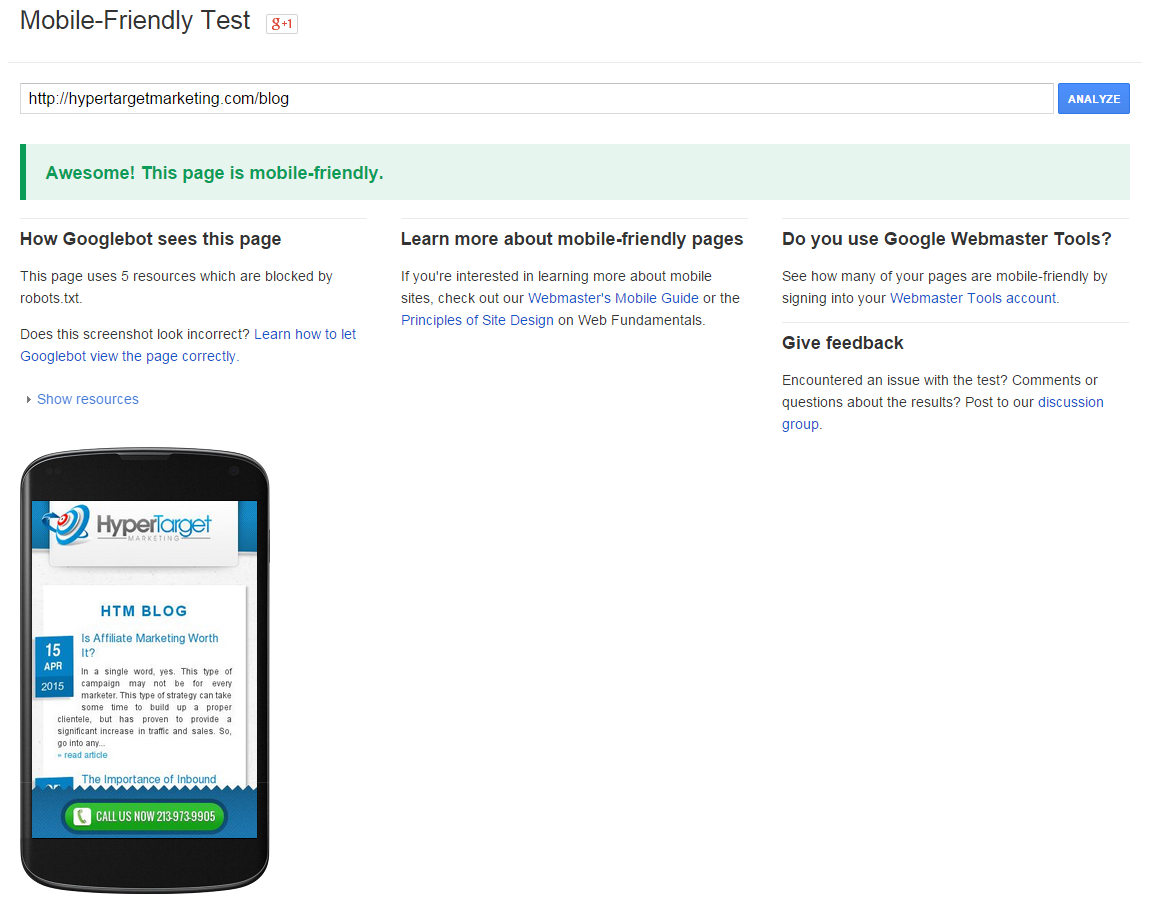
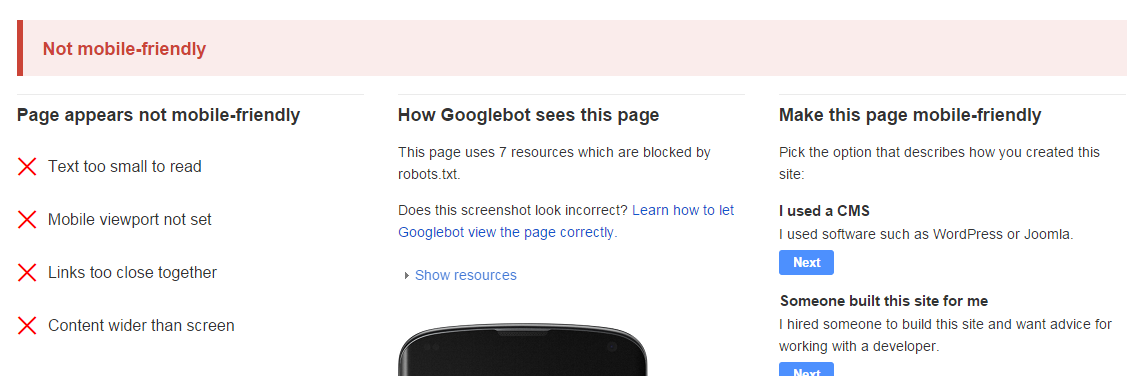
    This tool actually gives a breakdown of all issues that occurred from trying to load that site via mobile. Below we have included a screenshot showing exactly what you will see. The tool shows exactly how Google sees your page and if your site is not mobile friendly it will include a link explaining how to convert your site. It also shows each issue with your site specifically such as small text, page is too wide for mobile, and links are too close together – thus not very clickable, as shown below.

    HTMMobileFriendly


    NotMobileFriendly

    Benefits of Mobile

    Obviously, anyone could explain that social media traffic has greatly increased in the last 5 years alone, which means mobile marketing is importance. It isn’t only effective for the younger populous. Approximately half of the 65+ generation is using social media. This means that having a mobile website isn’t just about gaining the attention of young folks, but also older generations. Your web presence doesn’t have to be “hip” and flashy to be effective, it just needs to be simple and concise for everyone. In fact, an article from Pew Internet & American Life Project says that while young generations are moving away from blogging, more and more senior generations are moving towards blogging. This study also showed that most young adults are moving to “micro-blogging” which mainly consists of much shorter status updates instead of content rich blogging.

    For Your Marketing

    Google’s updates are oftentimes reflective of society. Mobile is important. Users have shown it is important and Google has solidified it. Google algorithm updates are updated to benefit search engine users and can be used as potential sign posts for what users want and how businesses can adapt to these needs. For example, mobile has been emphasized in the most recent update. If you have little to no mobile marketing, now might be the time to adopt a pay per call campaign, MMS (multi-media message service), mobile games and banner ads, or QR bar codes. The Google algorithm is constantly changing to adapt to user needs. Besides rankings and SEO, Google algorithm updates (like “Mobilegeddon”) can have impacts on your business, both positive and negative.

  • Avoiding Pay Per Call Fraud

    If you weren’t able to catch the action of LeadsCon don’t worry. We are here to fill you in on affiliate call fraud. Eric Evans, of HyperTarget Marketing moderated a panel at LeadsCon on this very topic. Here are some of the basics of what you need to keep in mind when trying to avoid these types of fraudulent behavior, not only in a call-based business, but in any marketing relationship.

    Fraudulent Call Specifics

    If you are running any type of call-based business it is imperative to make sure you are screening any potential incoming clients to confirm you won’t be scammed. There are several ways to do this. First, you can employ an automated answering system that automatically forwards frequent callers to a separate line. Secondly, a clear IVR (Interactive Voice Response) will not only weed out fraud callers, but also help your real clients get exactly where they need to go quickly and efficiently, which definitely helps with a first call resolution. Lastly, if you are unable to set up either of the previously mentioned items, then ask questions, and lots of them. While this isn’t always the most time effective method it will no doubt tell you who is real.

    Test Partnership Waters

    Make sure that who you are doing business with is legit. Relationships go quite a long way in any kind of business partnership. Start small when creating a new business endeavor. Have your inductee create some smaller content or outreach first to make sure they are a good fit with your marketing strategy. This not only eliminates the chances of them not having the same vision as you, but also makes sure they are who they say they are. This can also help if you want to check the kinds of viewers, followers, and customers they are bringing you are real.

    Be Clear About Your Needs

    If too much is left up to interpretation you could be setting the campaign up for failure. Set clear goals within a respectable and reasonable timeline with anyone worth working with. This way everyone involved knows exactly what is expected and there is no chance of trailing off or not getting the types of clients the business needs. This means that meticulous organization and documentation are key for success.

    Always Follow Up

    Even if you have clear guidelines set, they mean nothing unless there is follow through, especially if you are deciding to take on a new client or business partner. Set up multiple call backs and meetings to discuss your short and long term strategy plan. This is a good way to build rapport with a new client. Additionally, you never have to feel in the dark about exactly what is happening. Follow up doesn’t mean you have to micromanage all the ins and outs, but it does hold all parties exclusively accountable to the services exactly as they were discussed.

    Avoiding pay per call fraud is vital for anyone running a call marketing campaign. Make sure to keep these points in mind and be sure to visit panels and presentations when you are trade shows. You never know what you might learn.