Category: HTM Blog

  • Build A Steady Income With Recurring Billing

    Build A Steady Income With Recurring Billing

    One of the easiest and best ways to cash in on all the hard work it takes to make a sale is to base your sales model on recurring billing. The two types of products and services which are easily billed on a recurring basis are those which generate automatic sales (renewals and reorders) and automatic income (residuals.) These two recurring billing models are really two different ways to achieve the same goal, but they will be treated separately here. Additionally, these two areas are not always to cut and dry, and there is bound to be some overlap in certain products and offerings.

    Reorders and Renewals

    Reorders and renewals refer to products which can be automatically delivered as the customer is automatically charged. Examples of these kinds of products would an automatic shipment of vitamins with automatic billing, or a magazine subscription with monthly billing. When there is a physical object being delivered, it is easier to think of the process as “reordering,” though the customer may not have had to actually place a new order. Renewals would refer to a monthly subscription such as a membership to a website. The period of renewal or reorder may be monthly or even yearly, depending on the product and the offer.

    Residuals

    Residual income refers to doing something once and receiving income from that action well into the future. Artists, such as musicians and movie stars, are often paid for years when their music or movies are purchased down the line. So, in this case, it is possible that very little work goes into earning the residual, as sometimes residuals are earned for decades with absolutely no additional work by the producer. One good thing about residuals is that they can often be sold or transferred.

    The Benefits of Recurring Income

    The top reason affiliate marketers should get into products which give recurring income is that this sales model helps the marketer earn more over the lifetime of a product than selling it on a “one-time” payment model. For example, if you sold razors to men with the one-time model, your customer may purchase 10 razors now, but then buy from a competitor next time. But with the recurring model he would automatically purchase 10 razors per month from you, and even come to depend on and expect their delivery.


  • Recruiting The Right Affiliate – Not All Are Created Equal

    Recruiting The Right Affiliate – Not All Are Created Equal

    The world of affiliate marketing can seem a bit like the Wild West, complete with its own laws, customs, and characters. One of the ways that many affiliate marketers make sense of this hard-to- tame world is to never really try to understand it at all. They simply create a program, try to entice as many affiliates as possible to join, and then hope for the best. It goes without saying that this is not the best approach. Instead, the manager of an affiliate marketing program should carefully select the right people to get the job done; they should recruit the right affiliates. Here we will look at some tips for recruiting the right affiliates for your program.

    • Make Your Program Exclusive – In the world of affiliate marketing many managers take the “more is more” approach. They try to get as many affiliates as possible to join and promote the product or service, more or less throwing them all against the wall to see who will stick. This kind of approach can be successful, but carries great risks. Any affiliate marketer looking to build a brand would never let unscreened strangers represent their companies. As a business person who cares deeply about the image of your brand, it is essential that you take time to reject those potential affiliates which do not seem like they would represent your brand in the way you desire.
    • Ask to see previous earnings statements – The primary reason to become an affiliate marketer is to make net profits. This should be kept in mind when selecting affiliates for your program. Their needs to make a profit should match yours. They should be profit motivated as well as ethical, which is another important aspect of a good affiliate which we will see in the next bullet point. One of the best ways to judge the future production of a new affiliate is to take a look at their background. Do not be afraid to ask for a copy of previous earnings statements in order to validate their potential production.
    • Ask for Industry References and Check them – Another way you can judge the suitability of a potential affiliate is to ask him or her for references in the affiliate marketing or sales industries, and really follow up with a call. When doing this it is important to do some research in order to investigate if there is any connection between the reference and the potential marketer. In other words, check for the validity of the reference as well as for what they have to say about your potential affiliate.

    Seek Affiliates in Out-of-the-Usual Places – When looking for affiliates it is always best to target people who understand your product and care about how they represent your brand. But many times different affiliate marketers look for affiliates in the same places. This is like fishing in the same fishing hole as everyone else. Sure, you may want to concentrate efforts in the places you are most likely to encounter prospective affiliates, but you may strike gold by going outside the box. Check webpages and groups which cater to women, minorities, and seniors. Do some offline recruiting. The more you concentrate out of the box, the more likely you are to find a great recruiting avenue which you may have all to yourself.

  • Performance Content – Native English Speakers vs. Non-Native

    english-speakerEveryone knows that one of the best ways to generate superior search engine rankings is to constantly update your webpage or blog with interesting and relevant information. In fact, whether or not your potential customers decide to buy, call in, or take any other action may come down to what they ready on your website. But, not every marketer has the time or skills to write truly engaging content. Due to this situation a couple of alternatives have arisen, both involving having someone generate content for you. On the one hand you can pay a native English speaker, who has a background in writing, to produce your content for you. On the other hand you can pay a non-native English speaker, or someone who grew up speaking English as one of many languages. Here we will take a look at the pluses and minuses of both strategies.

    Native English Speaker

    Best Use: Use a native writer when you have a sophisticated audience, or when SEO is extremely important.

    Pros:  Native English speakers are more likely to grasp the language and idioms better than a non-native speaker. And because performance marketing is most prevalent among native English speakers, you are more likely to find a writer who understands your goals. Another pro is that an American writer is very likely to operate in a time zone which is very close to yours, if you are both in the United States.

    Cons: The biggest con of hiring a native English speaker is the cost. Though some bargains can be had, you will probably be able to hire 3 non-native writers (easily) for the cost of just one native English writer. Another con is that, though they are more expensive, native writers may still have to accept less than minimum wage (or very close) in order to write for you, depending on your pay structure.

    Non-Native Speaker

    Best Use: Use a non-native writer to produce massive amounts of content that you may have to edit yourself.

    Pros: The best reason to hire a non-native speaker is because they are cheap. There are numerous people from countries in Asia and Africa which can produce cheap content for websites and blogs, and many (but certainly not all) of them are relatively good producing English language content. There are even whole teams consisting of dozens of individuals ready to tackle larger jobs. This would serve as the second pro. It would be best to look for an individual or team with verifiable performance marketing and/or SEO experience.

    Cons: The cons of hiring a non-native English speaker would come down to writing quality and difficulty of communication. The writing quality of a non-native is generally far inferior to that of a native English writer, as would be expected. Differences in spelling, idiom, and many other differences all play a role. Communication can also be difficult when your waking hours are the sleeping hours of your writers. This is not always a major issue, as many non-native writers actually write at night in order to be awake when their clients are awake. But it could be a problem.

    Overall, the question of native vs. non-native writers is the age old question of quality vs. quantity. For those who want the absolute best content, a native writer is almost a must. Though there are some really impressive non-native writers, they are more likely to become in-demand, and raise their pricing accordingly.

  • Facebook For Affiliate Marketers: 101

    facebook affiliateLike it or not, Facebook appears to be here to stay, and with it the social media revolution will roll along. It is now a foregone conclusion that the world will continue to become more socially connected, with concepts like privacy and oversharing taking a back seat. But for affiliate marketers, this is good news regardless of their individual opinions about Facebook. Marketers should be able to see Facebook as a potential gold mine for all kinds of prospects, from people looking to join their organizations to people looking to learn about or purchase their products or services. As an affiliate marketer you should also be getting on the Facebook bandwagon. Here are some tips for using Facebook as an affiliate marketer:

    • Learn how to purchase Facebook Ads – Facebook has a number of ways to purchase ads including purchasing likes to a page, purchasing likes to an individual post, and paying for your ad to be displayed. Among the options of how to pay for your display ad are pay per click, and pay per impressions. All of these aspects should be carefully considered and tested before any major advertising outlay is spent.
    • Build a Fan Base – This tip seems like a no brainer, still should be mentioned. One of the reasons for using Facebook to market is in order to build a captive audience which pays attention to what you have to say. It is important that you give people a reason to pay attention to you, your company, and your offer – so be sure to put useful information into their newsfeeds.
    • Giveaways are still popular – Everyone loves to feel like they are getting something free or something for nothing. It is a great idea to offer your prospective customers a freebie, especially if your product is an information product. These kinds of giveaways helps your customers get to know you and trust the quality of your product before making the big purchase. Those offering a service could offer the first part of the service free, or give a free trial.
    • Be real – Affiliates promoting certain kinds of businesses or products are going to have a more difficult time with Facebook than others. For example, those in the dating niche may have it especially hard. One of the keys to not getting bounced from Facebook advertising, which does happen frequently, is to not go black hat. Be real and position your product in a likeable manner. Think about things from the Facebook advertising moderator’s point of view, and obey the terms of use.
    • Be positive but not obnoxious – Everyone appreciates a positive quote now and then. But simply posting a positive quote every day without context can seem like a cry for attention. Remember, the goal of Facebook for affiliate marketing is for your captive audience to pay attention to you, and eventually purchase your product. Instead of just posting a positive motivational quote every day, offer a brief 2 or 3 sentence true motivational story and then give a quote as the moral or takeaway.

    Go international – If your offering can be purchased by people in other countries, target them in your Facebook campaigns. Not only may the clicks (or other actions) be cheaper, but you may find far less competition for the attention of customers in different countries.

  • A Quick Guide To The Sales Funnel – For Affiliate Marketers

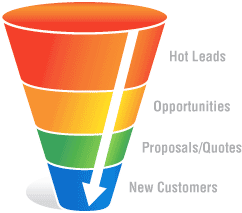
    sales-funnelA sales funnel is a process which can represent your entire sales process in one image. As a funnel is wide at the top and narrow at the bottom, so your sales funnel is meant to call the attention of a wide swath of potential clients in the beginning, and continue to whittle that group down until you reach those who will become paying clients. There are a lot of individual theories related to the sales funnel concept, and there are even tools to help you track your funnel. Here we will take a look at some basics of the sales funnel for an affiliate marketer.

    1. The first step in the sales funnel is broadcasting your marketing message to as many prospects as possible. This does not mean broadcasting to as many people as possible, as all people are not potential customers. For example, if you are advertising to seniors who may want a new walk-in bathtub, you would broadcast your message on seniors’ webpages, in AARP magazine, etc. For affiliate marketers, people usually enter the sales funnel when they enter their information on a landing page, or call in for more information about a product or service.
    2. The second step in the sales funnel will generally differ from business to business, and product to product, but usually includes some kind of customer contact. Here is it important to note that all the steps in the sales funnel are call and response. Now that the customer has given you their information or called your company (step 1), you may respond by replying with an auto responder series, sending them a newsletter, or giving them a free trial. In other words, step 2 is all about responding to the customer’s request for more information.
    3. The third step involves handling the customer’s response to step 2. Depending on the length of the sales funnel this may be the point where the actual sale is made. Other sales funnels will be longer, and may include the customer watching a video, then taking a webinar, then talking to a coach to ask any questions they have, and then finally making the purchase. So, step three and those after really just represent a series of steps the customer will take up to the point of making a purchase. Sometimes the sales funnel will even have a small purchase in earlier steps, leading to a larger purchase in later steps.

    As can be seen, the sales funnel can be as short as 2 steps, or as many steps as the affiliate feels is necessary to convince the prospect that the offer is worth purchasing. In 2013 there were some marketers who disputed the practicality of the sales funnel altogether, saying that prospects are not so readily predictable as to follow the well laid out steps. Considering that a sales funnel is meant to do 2 things: generate sales, and accurately track conversion rates of each step in the process, it is true that any disruption in either of these two metrics could cause the sales funnel concept to falter, but not necessarily fall apart. These would simply be signs that additional tracking metrics are needed, or that some steps of the process need to be improved or eliminated.

  • Affiliates: Insulate Your Sales Funnel Against This Hidden Foe

    Affiliates: Insulate Your Sales Funnel Against This Hidden Foe

    In the world of affiliate marketing the name of the game is sales. If an affiliate brings sales to the company that likely would not have happened without their involvement, then on a whole this is seen to be a net positive for the company. Of course there are other considerations, such as marketing and promotion techniques and conversion rates – but overall more sales are better. But determining which sales your company would have otherwise made, without the affiliate, is very important and can lead to some interesting conclusions.

    As can be read in this article, sometimes affiliate marketers simply send customers to purchase a product that they were going to purchase anyways, collecting a commission in the process. In extreme cases, customers actually stop the buying process, and then go through an affiliate link to continue it. Here is how it happens:

    1. Customer arrives to your website through your blog, PPC, or some other non-affiliate manner.
    2. Customer finds a product or service on your site, adds it to their cart, and proceeds to the check out.
    3. On the checkout page the customer sees the “Add Discount Code” field and instead of continuing the purchase without a discount code, decides to open another browser and search for one.
    4. When the customer searches “[Your company name] discount code” the top results take them to your affiliate’s websites, where the customer is presented a discount code, which may or may not be valid.
    5. The affiliate site puts a cookie in your customer’s computer, and redirects them back to your site, where they finish the purchase.
    6. Affiliate collects commission for the sale.

    This whole process may happen by accident or on purpose. The big take away here is that retailers should take note and make necessary changes to prevent this from happening.

    To read more from VentureBeat.com, click here.

  • Live Chat – A Must Have For Any Sales Team

    Live Chat – A Must Have For Any Sales Team

    In the old days an 800 number was absolutely essential for any nationwide sales team. The consumer came to rely on the toll-free number as a way to reach out to a company to ask question or place an order, while avoiding high long distance charges. Now, a new kind of communications platform is rising in popularity. The live chat, like the toll free number, is helping increase customer contact options. But the live chat option has a few advantages over a phone call.

    Here are some reasons every company should have a live chat operation:

    • People at work may not be able to talk on the phone, but they can often use their computers to live chat. This will allow them to contact your company when they have the initial impulse to do so, instead of having to wait until later.
    • Live chat provides a transcript of the conversation which can be saved by your company and the customer. This can reduce the customer’s need to call in again to request the same information. Also, it ensures your company will capture the potential client’s vital information such as name, email, and phone number.
    • Live chat operators can be offshore, and therefore costs less. Unlike phone operators which may have a distinct accent, offshore live chat operators suffer no disadvantage as compared to American workers doing the same job.
    • Offering a continually staffed live chat service on your website shows that your company is professional and responsive.

    To read more from Kiss Metrics, click here.

  • Does Your Company Understand Real Time Marketing?

    Does Your Company Understand Real Time Marketing?

    In the Digital Age everything is moving toward being instantaneous. The amazing speed of information generation and sharing means that the fight for a consumer’s attention is heating up like never before. It also means that marketers and advertisers have less time to get their point across to consumers. In the Twitter Age, you should be able to get your complete marketing message to your prospects in the span of 140 characters or less.

    Companies with long drawn out processes are facing increased competition from those which can deliver the same, or similar, products or services in less time. This means a reduction in hedging and equivocating, and an increase in experienced and bold professionals coming together to bring a product to market. For marketers, reduced ramp-up time means being able to literally incorporate today’s headlines into tomorrow’s marketing message. This is one of the reasons social media has grown to such a powerful marketing platform: It allows marketers to respond to their market and client base in real time.

    The companies which survive into the 21st century will be those which are ready to take the chances necessary to make the big score. That may mean trying a new marketing platform, or expanding or contracting the product base. The reason these companies will survive is not because real time decision making is any better than the older, slower model, but it is because this is what the marketplace and customer base demands.

    To read more from Ad Age, click here.

  • Crowdsourcing For Marketers – 101

    Crowdsourcing For Marketers – 101

    Crowdsourcing is a fancy way of saying outsourcing – but with a twist. While outsourcing usually refers to hiring contractors or an agency to perform a service or handle a project, crowdsourcing refers to the practice of allowing a large group of people (the crowd) to effectively complete the same job more efficiently. This is a relatively new approach to getting a job done, and is being employed by firms which specialize in everything from blogging to marketing. Here are some examples of ways marketing companies have used crowdsourcing to fulfill their needs:

    One of the original applications of crowdsourcing on the internet was when companies began to pay independent webmasters a commission every time the webmaster’s site generated a visitor to the paying company’s site (a click). There have been much iterations on this idea, including pay per sale, and pay per email submit. But the idea is really the same.

    A major debt relief company has affiliates which market its services, which they then pay by the sale or lead. They have even set up many ways for customers to contact the company, including through the marketer’s website, email, and a special phone number assigned to the marketer.

    A lead generation company outsources its cold calling to individuals, who work from home while connected to the company’s lead generation platform.

    There are literally hundreds of ways to crowd source. In fact, so many marketing firms are using this way to generate prospect and sales, that it has quickly become a mainstay in a majority of internet marketing campaigns.
    To read more from the Huffington Post, click here.

  • A Brief Introduction To Affiliate Marketing

    A Brief Introduction To Affiliate Marketing

    In this ever-expanding internet age, one of the most effective ways for companies to increase brand awareness is through affiliate marketing. To put it in the simplest terms, affiliate marketing involves a company “recruiting” other companies or individuals to market their products and services for a commission. Under this definition there are two different forms of affiliate marketing:

    • The first is when a person or business offers an affiliate program to others. The ultimate goal in this kind of marketing is to utilize the power of exponential networking to drive sales leads to the company’s website.
    • The second is when a company or individual signs up as the affiliate for another business. The goal of becoming an affiliate is to capitalize on one’s own ability to drive traffic to the company offering the affiliate program, with the goal of making a sale. Affiliates are then paid a commission for each lead and/or sale they bring to the website.

    Affiliate marketing works differently and more effectively than other kinds of marketing because companies are able to reach untapped markets that the company may not have otherwise been able to draw to their website. Most affiliate programs have come to utilize revenue sharing or pay per sale as a method of compensation. Other methods like pay-per-click were popular in years past but have become obsolete mostly because of various forms of fraud that were involved in their implementation. Most people who participate in affiliate marketing enjoy the work because there is no time or effort investment involved in selling a product. The product already exists so for affiliates it is just a matter of finding creative ways to market that product to a particular market or social or business network.

    For more from CJ.com, click here.