Category: HTM Blog

  • 5 Tips for Creating More Effective Landing Pages

    5 Tips for Creating More Effective Landing Pages

    Using landing pages for more effective lead generation is pretty much a staple in the internet marketer’s toolbox. Having a single page with a targeted message to direct visitors creates a scenario that allows marketers to capture leads at a much higher rate than typical pages. However, even with a focused marketing message, converting visitors to leads can still be difficult. To help increase your landing page conversions, make sure you’re using these top tips.

    Before we begin, it’s important to make sure you have all the critical components on your actual landing page.

    Headline
    Your headline copy should support your offer and be compelling enough to make your visitor want to read more.

    Description of Offer
    This doesn’t have to be an incredibly lengthy description. You really just need to include enough information to prompt a visitor to want to sign up for your offer or take your intended action. Focus on the benefit for your users.

    Image
    This is best if it is an image of your product or something related to your offer. For example, a picture of a tropical beach would be great for a beach vacation giveaway. For a free report giveaway, a book style graphic would be ideal.

    Testimonials
    Social proof can go a long way toward proving that your product or offer is worthy of your visitors’ time. Make sure to include any relevant testimonials, badges or awards you may have received.

    Lead Capture Form
    Above all, you can’t capture leads if you don’t have form for them to fill out. Make sure it captures at least the basic information of their name and email address.

    Now that you know all the basic elements of a landing page, let’s move on to how you can improve your conversion rates.

    #1 – Keep Your Offer True
    If you say you are going to give something away for filling out a form, actually give that thing away. Your call-to-action must remain the same throughout the entire process or you’ll lose your visitors’ trust. If this happens, not only will they not complete the offer now, but they’ll hardly be likely to participate in any other future offers.

    #2 – Stay Focused
    The point of a landing page is to sell one offer. Too many times landing pages are cluttered with multiple marketing messages and offers. Keep it simple and make sure any text or calls to action you use relate specifically to your offer.

    #3 – Remove Distractions
    A landing page is created to provide a distraction free zone for people to focus on your particular marketing message. Having extra elements like your site’s main navigation or footer links can entice the visitor to click elsewhere and potentially forget about the offer altogether. The only navigation you need on a landing page is a link to your homepage should they refuse the offer. This can easily be achieved, distraction-free, by linking your logo to the homepage.

    #4 – Keep Your Formatting Simple
    While you may have tons to tell about your offer, the average internet user has an incredibly short attention span. You can keep their focus by using bulleted lists, graphics and less overall text. Think about the pages you stay and read. Chances are when you’re confronted with a block of huge text, you’ll skip the reading or bookmark it for later (and then forget about it).

    #5 – Only Ask for What You Need
    This is not just a lifetime lesson, but a crucial conversion tip as well. The more information you ask for, the higher the odds that people will NOT follow through. While it would be nice to have all the demographic information for everyone who visits our page, it’s not realistic to expect people to take the time to provide the extra information. People want to get in and get out. Keep that in mind when determining what information to ask for.

    Have a special promotion or offer you’d like to advertise? Let us help you by creating a landing page campaign!

  • Mobile Marketing Tips

    Mobile Marketing Tips

    Did you know that 56% of American adults are now smartphone owners? Even more impressive, by the end of 2013, there will be more mobile devices on Earth than people. If that’s not enough of a reason to jump on the mobile bandwagon, I don’t know what is. The truth is, mobile is here to stay and if you’re not marketing to these users, you’re missing out on a huge opportunity. To help get you started, below are four tips to help you kick-start your mobile marketing efforts straight away.

    #1 – Make sure you’re mobile friendly.
    Seems simple enough, but when it comes to adding another expense to your marketing or website development budget, it’s easy to see why making your site mobile-friendly can get pushed down the list of to-dos. However, not having a mobile-friendly site could be costing your company extra income opportunities. Mobile users typically make up nearly 20% of visitors to web sites. That’s a huge number to ignore.

    At the very least, you should keep these things in mind to make sure your site is somewhat mobile-friendly.

    1. Have your name, business address, phone number, store hours and any other relevant information in a easy to find spot, regardless of the device.
    2. Make sure users can easily do what it is you want them to do regardless of the device they are using. For instance, if you want to sell something, is it easy for a user to click on the add to cart button? Does your shopping cart actually work across all devices? These are areas that could cause you to miss income opportunities if ignored.
    3. Think about what each user will want to do when accessing your website through a different device. If they are using a smartphone, chances are they want store hours or other quick-to-access information. Tablet and desktop users are more likely to be in research and then buy mode.

    Take some time and really analyze your site through the various devices and see what things could be improved. More often than not, you’ll realize that the cost associated with making your site mobile-friendly will be offset by the extra sales you’ll receive.

    #2 – Be active on social media.
    According to a comScore survey, approximately 40% of respondents interact with local businesses on social media. That means if you’re not there, they are interacting with your competitors instead. It pays to be where your customers are, and they are definitely using social media, especially on mobile devices.

    It would be beneficial to keep your mobile users in mind when crafting your messages. Not all mobile users are going to take the time to click on an article. However, they are more likely to share a funny or thought-provoking image or a fun fact. Make sure you keep your updates short and to the point, as mobile users aren’t likely to click on anything to “read more.” A good variety of posts will help you attract not just your typical desktop user, but also mobile users.

    #3 – Use location-based services.
    Besides helping give you a bump in search engine rankings, location-based services like Foursquare can help increase awareness of your company to new potential customers. More importantly, since most of these services are used on smartphones, they can expose your company  to new customers who are nearby and may be willing to stop by to take a look.

    Another great benefit from these types of sites is the ability to keep track of how often customers are actually stopping by and “checking in.” If you notice a higher number of check-ins than usual, you can look back and see if it was due to an extra promotion you were running.

    #4 – Keep your promotions mobile-friendly.
    Sending out an e-mail promotion? How does it look on your smartphone? Can you easily read the call-to-action or the promotion? Is the subject line of your well-crafted email cut short? More and more people are reading their email on the phone – especially when they have a few minutes to kill. This is a great opportunity to have a user’s undivided attention for a few minutes. It pays to take some extra steps to make sure you’re not wasting it.

  • 6 Often Overlooked Lead Generation Opportunities

    Garnering interest in your product or service is a key element to online promotion. That means getting your message out to as many targeted people as possible. While everyone knows the benefits of social media, traditional advertising, networking, etc, there are other opportunities or tactics that you may have overlooked. Here are a few to consider:

    Q&A Sites
    How do you establish your proficiency or credibility at something? Become an expert! Q&A sites such as Quora offer the perfect platform for this tactic. Take a few minutes out each day to offer advice and over time you’ll become a respected expert. This can be a huge opportunity for lead generation.

    Social Media Groups
    An older tactic for talking up your expertise in a subject was to join related forums and establish an identity there. Now, there’s an even better way – groups. Groups are similar to forums, except they are even more targeted to a specific niche. In addition, the big social media sites have the perfect platforms and people to help get you started. Google+ and Facebook have a plethora of extremely popular groups (communities) you can join. If you don’t see one you like, you can always start one yourself.

    Videos
    People need to be able to see themselves using a product or service. Videos are a quick way to facilitate this need. The best rule of practice here is to keep it short and simple. Showcase the product or service in the most streamlined way possible. Something to consider…

    Visitors to housewares retailer StacksAndStacks.com were 144 percent more likely to make a purchase after seeing a product video, according to analytics technology company Kissmetrics.

    Error & Confirmation Pages
    Error and thank you pages are often overlooked gold-mines of opportunity for conversions. A person is trying to do or has actually done something on your site and is looking for some direction. Here’s your chance to have their undivided attention. Use this opportunity to lead them down your desired path.

    Be Visible
    People are always watching your brand and how you conduct business. For every person that actually interacts with your brand, there are a good number more just lurking and contemplating whether they will become brand loyal. The best way to convert these lurkers into actual customers is to be visible and interactive with your current customer base. Answer questions on your Facebook and Twitter accounts. Handle bad reviews on consumer review sites. When people see how you conduct your business on a daily basis they can be assured of what type of company they will be buying from.

    Surveys & Polls
    Surveys and polls have more benefit than just acquiring information from potential prospects. They also bring attention to your company and services your company may offer. For example, you could ask a question such as, “Which of our services would you most be interested in?” Then, provide a list of services your company actually offers. For people who don’t know all of your offerings, this is a simple way to make them aware while also gathering valuable customer data.

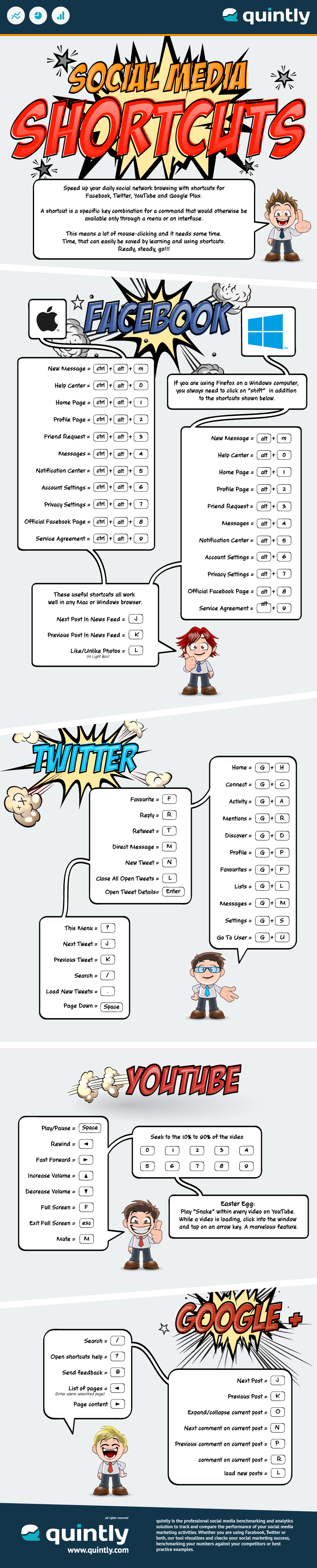
  • Infographic: Social Media Shortcuts

    Time is a precious commodity that we are all trying to savor. When it comes to one of the biggest time-sinks online, social media, anything we can do to be more productivity is a welcome boon. With this in mind, the next time you’re on your favorite social media platform, try some of these social media shortcuts to help boost your productivity. Let’s face it – no one really wants to spend all day looking at cute kitties!

    infographic social media shortcuts

  • Applying the Hierarchy of Effects (AIDA) to Lead Generation

    In today’s market, simply spending money on clever advertising messages isn’t going to win you brand loyalty or a mass of new customers like it may have in the past. Customers are more educated and more distrustful of companies and therefore need more interaction with a brand than just a hollow advertising campaign. People choose to buy from companies they believe in, or at least believe in the message the company is promoting.

    While times have changed, some marketing models have not, and may even prove more useful today than when first created. One such example is the AIDA model, commonly referred to as the Hierarchy of Effects. This model is credited to American advertising advocate E. St. Elmo Lewis. He postulated that:

    The mission of an advertisement is to attract a reader, so that he will look at the advertisement and start to read it; then to interest him, so that he will continue to read it; then to convince him, so that when he has read it he will believe it. If an advertisement contains these three qualities of success, it is a successful advertisement.

    Broken down, AIDA is simply this:

    • A – Attention (or Awareness)
    • I – Interest
    • D – Desire
    • A – Action

    For everything we purchase, we must go through these stages. A product has to attract our attention, then garner our interest to learn more about it, and then give us a feeling of desire for the product strong enough to bring us into action to actually purchase it.

    It’s really quite simple when you break it down – which is great news for lead generation. When you know the steps or emotions a potential customer must go through to get to the “action” stage, you can lead them along with the right material to evoke the right feelings.

    Even better, each step really only needs to do the job of getting the person to the next stage. You don’t need to waste time trying to sell someone who has never heard of your product or company. You just need to get their attention. So how do you do this? Here are a few tips to consider:

    Attention

    In short, the best way to get the attention you need is to be everywhere that your target consumer is. When you think of this stage as also being the “awareness” stage, it helps to get you in the right frame of mind. Set up a company blog, look at setting up partnerships with related, but non-competing companies and always be promoting. You don’t have to do big, attention-getting stunts to attract notice. Spending some quality time establishing who you could partner with or where your target market spends their time can create an even better, long-lasting impression than a few marketing stunts.

    Interest

    Traditionally, advertising would gain your interest by telling you how awesome some product was. Today, however, consumers are more “me” focused. They want to know how this product will better their lives. To gain interest, you have to demonstrate the benefits and advantages of the product or service in a way that will compel them to want to learn more. What pain points does your product solve? How will your product make your target consumer’s life easier, better, or safer?

    Desire

    Once your potential customer is interested in the product or service, it’s the right time to provide them with enough information to create desire for it. In the case of lead generation, you may not need to worry about creating a sense of desire for the actual purchase of the product, but rather the desire to know more. This is where you work on removing obstacles or barriers that may come up when evaluating the product or service. You will want to be addressing cost, ease of delivery, effectiveness of the product, etc. in a way that creates more desire for your product.

    Action

    The final step is to have your potential customer take some sort of action. With lead generation that could mean anything from filling out a contact form to calling a representative, or even subscribing to a newsletter. Remember, the end goal is always to get your potential customer to take some sort of action. The goal of AIDA is to help you streamline the process so you can keep more potential customers during the sales cycle.

  • 4 Strategies for Getting Someone To Say “Yes” Through Your Website

    For most companies, a company website is about getting someone interested in their product or service, and hopefully, at some point, selling it to them. On the surface, this may seem like an easy task. Set up a website, get people to go to it and watch the money come in.

    While, yes, it really is a matter of successfully doing those three things. If you dig a little deeper and you’ll soon realize it takes a bit more concentrated effort. In fact, it takes a real knowledge and understanding of your target market to make your website truly work for you. Even if you do manage to get tons of people to your site, if it doesn’t convert, you’re wasting time, money and energy.

    Keep in mind that conversion can be applied to any action you want someone to take while visiting your website. You may only want someone to sign up for your newsletter, or to like your Facebook page. Or, you may want them to actually buy a product. Before you can get people to say “yes” to something, you need to figure out what you want them to say “yes” to.

    Once you’ve established the goal of your website, you can turn your attention to making sure it converts. Here are a few tips to help you get more “yes” responses from your visitors.

    1. Ask for the “yes”
    It may sound incredible simply, but take a look at a number of sites within your industry and see just how many are actually asking the viewer to take an action. You’ll be surprised at the results. Many sites focus on providing all the information, but never actually ask the viewer to take the next step. Don’t make that mistake with your own website and always ask for what you want.

    2. Make it super simple
    Nothing is more confusing than not knowing what’s expected. You want to make sure that your intentions are clear and upfront. Avoid making things too complicated. For instance, if you ask for too many actions, people will become confused and end up taking no action. If it isn’t clear what they are supposed to do, again, no action will be taken. If there is too much information before they can take an action, they might give up. Your goal is to go over your material to make sure that there is the perfect amount of education about your product or service mixed with the right visuals to prompt the user to take some sort of action.

    3. Craft the message or action to your target market
    If you ask a cook to sign up for a meal delivery service, you’re probably not going to get as great of a response as you would asking a single, working executive. The point here is to make sure you aren’t working against yourself with your marketing messages. Really think about your ideal customer and what their needs and wants are. Then, craft your marketing messages with them in mind. This will help you get to more people saying yes than no.

    4. Be honest and transparent
    Now more than ever, honesty has become a business commodity that consumers are willing to purchase. This means making sure you deliver on your promises and generally being a “good” business. This will help spread word of mouth advertising, which will in turn help you cultivate a more targeted visitor base to your website. The more targeted your visitor base is, the less no’s you’ll receive. It pays to be a company with integrity that has the interest of their customers in mind. Not only will you get more people saying “yes” to your initial offer, but chances are you’ll get them for life.

  • What’s Your Lead Generation Objective?

    What’s Your Lead Generation Objective?

    The beginning ingredient for most companies’ sales success is the lead. Leads signal potential sales and future customers. They are a good thing. However, not every lead should be treated equally. If you haven’t established guidelines or objectives for your leads, you could get inundated with unqualified or non-targeted leads. This results in not only a waste of time, but a loss in morale within your company as well. Rejection hurts, and it may not always be obvious that the source of it is in the actual quality of the lead itself.

    You’ll often find that in sales teams, leads can be referred to as cold, warm or hot. This typically refers to how likely a lead will turn into a sale. A cold lead would obviously be the least likely. Imagine if you could work on having less cold leads and more warm and hot ones. With a little foresight and planning at the lead generation step, you could improve the overall quality of all leads coming in.

    Here are a few ways to do just that…

    Understand what makes a good lead.
    Who is the ideal prospect? It has to be more than just “they are ready to buy right now.” What makes them ready to buy? Why are they more likely to use your services over other potential leads? What makes them the easiest to convert? Digging deeper into your potential customer’s mindset will help you find the triggers for great lead generation.

    Determine your overall lead goal.
    For some companies, actually making a sale isn’t the end goal. Maybe they just want to capture information for a future event or sale. Maybe they just want greater insight into their audience demographic, or they just want to expand their reach. Knowing what a “happy” end result of each lead is will help you work your way backwards to making sure the people you are targeting will result in a great “hot” lead.

    Know your red flags.
    Sometimes in order to determine what you want, you have to look at what you don’t want. This will help you set up conditions or questions to eliminate bad prospects. For instance, if you are a graphic artist, you probably don’t want to target companies that have an in-house art department. Knowing this, you would set up some type of parameter that would help you eliminate leads from companies with an in-house art department. Take some time and examine what types of leads aren’t worth the time and effort.

    Tailor your efforts for the results you want.
    It makes sense that if you want to find leads for people looking to get their haircut you might set up a lead generation system (such as a contest for a free haircut) at a nail salon. The customers in the nail salon would be in the fashion/beauty mindset and more likely to be a targeted prospect. However, if you set up the same type of lead generation system at a chiropractor, you might get some leads, but they may not as equally suited. If you know what makes a great lead, you can start tailoring your lead generation efforts to find more of those types of leads.

  • What Does Your Sales Funnel Really Look Like?

    What Does Your Sales Funnel Really Look Like?

    If your business involves direct selling, you probably know about the sales funnel or pipeline. A sales funnel is a great tool for determining your sales process and correctly identifying the stage where a potential customer may be. It is also extremely helpful in determining upcoming income potential and identifying any problem areas within your sales process.

    However, there is a downside to the sales funnel as well. If you aren’t accurately recording the stages, you won’t have an accurate view of your income potential. For instance, marking someone as a potential prospect when they make it clear they are not going to purchase from you, but instead tell you to call them back at a later time isn’t an accurate reflection of that communication.

    Let’s face it – sales and lead generation is difficult. Not just in finding leads, but on your psyche as well. You have to be tough, understanding and positive all the time. You have to face the possibility that rejection could come from every interaction, and your main goal is to figure out ways to overcome that possible rejection.

    On top of it all, your number of sales or potential sales is a figure that determines your worth or value to your company. With all these factors in mind, it’s easy to see why your sales funnel might not be accurate. No one wants to admit they might not be doing as well as they should be.

    The problem is this – when you allow this to go on, you are only hurting yourself. When you aren’t taking a real look at what your funnel looks like, you can overlook actual problem areas that could be fixed. For instance, if you are having trouble getting past your initial communication, it could be your opening pitch or even the quality of leads you are finding. However, if you don’t examine your funnel honestly, you may never know, and therefore never improve, the situation.

    In the example above, if you determine that the quality of leads you are getting is sub par, you can take steps to find a different lead provider.

    Transparency is the ultimate sales tool. It allows you to know exactly where you stand without any doubt. If you’ve been running into issues with your pipeline take some time and evaluate yours by asking yourself these questions:

    • Does this prospect actually belong in this part of my pipeline?
    • How long has this prospect been in this pipeline? Why? What can I do to move it along or remove it?
    • When was the last time I talked to this prospect?
    • Has anything changed that might have handled this prospect’s last objection?
    • Is this really a prospect or a dead deal?
    • What can I do to increase the quality of prospects I’m engaging with?


  • How to Determine Your Target Market

    How to Determine Your Target Market

    When it comes to thinking about who would want your products or services, the dream scenario always seems to be “everyone.” We get visions of global brands like Coca Cola and imagine everyone in the world will want our fabulous product or service. The fact is – this isn’t going to happen, nor is it practical to think it will. Once any visions of grandeur are allowed to pass, you can start focusing on what will really work – honing in on your actual target market.

    While, yes, it would be lovely for everyone to want our product, the reality is there’s only a few specific groups of people who will LOVE what you are offering. If you’re in business, you’ve probably heard of the 80/20 rule (the Pareto principle). 20% of your customers will bring in 80% of your revenue. In the spirit of the 80/20 rule, taking the time to truly define your target market will help you target more of that 20%.

    So how do you go about finding that golden 20%? Here are a few ways to help you define your target market:

    Who Does Your Product Speak To?

    The most effective way to find your target market is to ask yourself the hard questions about your product. Who does it stand to benefit the most? Why would they want it? How does it make that group’s life easier? What is the purpose of your product or service? Just by answering these types of questions, you’ll start to get a better picture of who your ideal target market is.

    Examine Your Current Customers

    The easiest way to find out who wants what you’re offering is to see who has already purchased from you. If you aren’t collecting demographic information during each transaction, craft a survey and ask your previous customers to fill it out. Ask them questions about their interests, hobbies, jobs, etc. so you can get a thorough understanding of who your buyers actually are. Doing this in the form of a contest is a great way to ensure a good amount of responses.

    Examine Your Competitors

    You can glean a lot of industry information just by checking out what your competitors are doing from time to time. Look over their social media accounts and check up on forums or review sites to see what type of customers they are attracting. You don’t really want to use this information to go after the same customer, but it can give you a good idea of any groups or niches that might have been overlooked.

    Go Over the Basics

    When looking at your product offerings, it can often become quite clear that targeting some demographics will yield higher results than others. If you have a wedding catering hall, you’ll probably have better luck targeting younger women. If you sell golf equipment, you’ll have a better response targeting men than you would women. When looking at your products, take some time to go over your basic demographics and see if there is anyway to single out a specific group to target. Areas to examine include:

    • Age
    • Gender
    • Location
    • Income level
    • Education level
    • Marital status
    • Occupation
    • Ethnicity
    • Value of home
    • Religious affiliation
    • Political affiliation

    Dig A Little Deeper

    Once you’ve established the basics of your target market, it’s a good idea to dig a little deeper. For instance, if you are selling natural supplements, targeting consumers who are either vegetarian, eco-conscious or athletes would help you get better results than a generic marketing campaign. Consider determining these characteristics:

    • Hobbies and interests
    • Clubs or associations
    • Lifestyles
    • Belief systems or values
    • Family dynamics
    • Social influence
    • Blogs or websites they visit
    • Social media habits
    • Shopping habits

    Now that you have this information, you need to write it as a simple paragraph to help you clearly define who it is specifically you want to target. If you can’t write it out, then you don’t have something clear and defined that you can share within your company. If you can’t share who your target market is than you’ll end up spinning your wheels targeting the 80% who will only bring in 20% of your revenue.


  • 4 Tips for Optimizing Your Site for Mobile Users

    4 Tips for Optimizing Your Site for Mobile Users

    If you haven’t thought about mobile visitors to your site, you might want to start. Consider these stats…

    • 50.4% of all US mobile subscribers own smartphones (Nielsen 2012))
    • Mobile search queries have grown 5X in the past two years. (Google, 2012)
    • 95% of smartphone users have looked for local information and 61% call a business after searching. (Google, 2011)
    • 90% of smartphone searches result in an action – purchasing, visiting a business, etc. (Google, 2011)
    • Mobile customers will likely account for $163 billion in sales worldwide by 2015. (MobileCommerceDaily, 2011)

    These figures make a compelling argument for making sure your site is optimized for the mobile user. But even before you do that, you need to make sure that mobile users can actually find your site. Luckily, you don’t have to make too many changes to stand out in the mobile world. Here are a few tips to help you get started:

    #1 – Consider the mobile user’s motives

    The motives of a mobile user are typically completely different than the average Internet browser. Usually they have some general end goal in mind. They want information or they want to buy fast. If you know why they might be looking for your site, it will help you present information in a way that you will be found. For instance, would they be..

    • looking for a location, hours of opening or directions?
    • searching for a quick how-to?
    • in the need for instant information?

    Consider why and when you personally use your mobile searches. This will help you get inside the mind of the mobile user and make sure that certain information is easily available.

    #2 – Keep mobile information prominent

    If someone is looking for a bakery near them, they are likely to type in “bakery + city name.” If you have this information in text on your site or in your page title, you have a higher chance of showing up when they search for that phrase.

    #3 – Follow best SEO (search engine optimization) practices

    • Optimize your mobile website speed. You can check it here. If it’s slow, consider these best practice tips from Google.
    • If you have a dedicated mobile site or pages, make sure your keywords are targeting your mobile users. Also keep in mind that titles and meta descriptions for mobile searches are shorter than on a desktop browser.
    • Keep content on your pages relevant and useful to the mobile searcher. Don’t put anything that isn’t needed as it will slow down your pages and be a distraction for the mobile user.

    #4 – Always keep the mobile user in mind with your site structure and design

    This can’t be reiterated enough. The mobile user will be in a different mindset than the typical web surfer. Not only will they be thinking differently, but they’ll also literally be in a different place. Typically, you’ll find a mobile user is accessing your site on the go or while sitting somewhere (couch, commute, waiting room, etc.).  That means you need to make sure your site fits these needs. Animated graphics, extraneous text, small sign up forms are all things that make for a miserable mobile experience.

    You may have optimized your site to attract the mobile user, but you also need to make sure they stick around and interact with your site in the way you desire. See how mobile-friendly your site really is by asking staff members, friends and family to visit the site and tell you how the user experience was. Then make adjustments accordingly.