Category: Performance Marketing

  • Getting Into Performance Marketing Requires Investment – Like Any Other Business

    Getting Into Performance Marketing Requires Investment – Like Any Other Business

    When it comes to performance marketing, most people take an interest because they have been told that it is a lucrative way to earn money from home and eventually will allow for the marketer to quit his or her day job. While that may be true to some extent, the reality of performance marketing should be put out there so that people who are thinking about getting involved in it truly understand what they are getting into. One of the most frequently asked questions about performance marketing is “how do I get involved in performance marketing with little money or even no money and without using a credit card?” They are wondering, in other words, how they can begin to make money with performance marketing despite not having the money for the typical start-up costs.

    The answer to this often asked question is that while it is not necessarily impossible to get into performance marketing with no money or credit card, it is extremely difficult. Or perhaps more accurately put, it can be done but the results are likely to be so miniscule that it probably won’t be worth your time.

    Most people who do dive into performance marketing without a decent amount of start-up cash rely on search engines and free traffic generating methods like Craigslist and Backpage and the like. The problem with these is that they are very restrictive in their user policies and have several other drawbacks that make it very hard to generate any meaningful results. Performance marketing, at its core, is like any other business venture in that it involves a high level of risk for the investor. The vast majority of people who get into PM lose money in the initial stages. And as a result most who start don’t stick with it because of the ease with which they lose money in this venture. That said, if you are serious about getting into performance marketing, you should only invest money that you are confident you can afford to lose.

    It is advisable that anyone looking to invest in a PM program should have between $1,000 and $2,000 set aside specifically for the expenses that are involved in making for a successful go at it. If debt is an issue in your finances, it is a good idea to eradicate as much of it as possible before you begin. If you do have a credit card, don’t use it for performance marketing unless you have the means to pay it off on time. And if you don’t have a credit card and you’re serious about performance marketing, then get one. Not all traffic sources accept PayPal, e-checks, or bank wires, so having a valid credit card or at least a debit card is strongly recommended. Without a credit card, you can expect to run into a slew of problems such as limited sources for traffic, since most of them require a credit card. Slow processing times can also be an issue because other forms of payment can take days or even weeks to confirm. Finally, you may be charged additional fees since many providers prefer credit card payments and charge a fee for those who don’t use them.

    This isn’t an attempt to discourage anyone from performance marketing without money or a credit card. It is simply a reality check. But if you are determined and you believe you can make it happen that way, then go for it. But remember that you did read this article and were advised otherwise. Good luck!


  • Pay Per Call Becoming Hottest Thing Since Sunburn In Online Marketing

    businessman-in-the-office-2-1287062-mAlthough performance marketing has proven itself over the last few years as one of the premier money making business platform in the world, it is still a matter of opinion as to how it will fare in the years to come. Businesses are always looking for the virtual magic pill that will generate strong, long-term online profits, and understandably so. That said, how does performance marketing in general and pay per call marketing in particular, allow that to happen?

    Forbes predicted way, way back in 2012 that Pay per Call marketing had the potential to be ten times the marketing juggernaut that pay per click has become. Good began offering Pay per Call advertising back in 2010 and within two years saw it generating upwards of 15 million calls every month for advertisers. With numbers like those it is pretty obvious that Pay per Call is going to be something that will be impossible for any advertiser to ignore. In fact, it already is.

    With Pay per Call being as white hot as it is right now, and is likely to remain for the foreseeable future, there is one element of the world of e-commerce that must be utilized in conjunction with this profit generating tool – mobile marketing. While there still is a significant enough percentage of online users sitting at their desks using desktop computers, more and more of them are switching to either tablets or smartphone to do the majority of their online activities. Fully 45 percent of people who use smartphones have used those devices to search for products and services over the last seven days. Additionally, it is expected that there will be nearly 30 billion more internet searches on mobile devices than on desktop devices by 2016. With that in mind, advertisers will be looking for a way to integrate Pay per Call into their mobile marketing strategy. The revenue generated for those who do so intelligently could be astronomical.

    Research has shown that leads are converted into sales more efficiently when some level of human interaction is involved. In other words, people prefer to deal with other human beings when making transactions and doing business. That being the case, Pay per Call is a no-brainer for any marketing strategy. Advertising networks will need to be equipped with the right resources and tools to allow marketers to succeed with Pay per Call. It isn’t just a plug-and-play type of endeavor. It requires real strategy and the right network. The performance marketing industry isn’t going anywhere. It is expected that spending therein will be well over $3 billion in 2014 and will climb as high as nearly $5 billion by the time the next presidential election comes. So any doubters who might be questioning the validity and profitability of performance marketing may need to recheck their numbers. And with a Pay per Call campaign integrated into the right performance marketing campaign, even the sky may not be the limit for businesses.

  • The Advantages of Stealth Marketing in the Pay per Call Movement

    The Advantages of Stealth Marketing in the Pay per Call Movement

    Stealth marketing is the latest soon-to-be-overused buzz term that is picking up momentum in the world of performance marketers. It has earned something of an unsavory reputation as a type of underhanded and manipulative form of marketing because of a few unscrupulous individuals who have used the tactics in those kinds of ways. Even the term itself – stealth marketing – carries with it an inherent tone of sneakiness that comes off as something that is designed to line the pockets of advertisers at the expense of their customers. However, stealth marketing – sometimes referred to as undercover marketing (which admittedly sounds just as ominous) – is simply a form of advertising that allows performance marketers the opportunity to market their business without damaging their reputations. Pay per Call promotions are among the most effective means for advertisers to harness the power of stealth marketing, and there are a variety of ways in which they do so.

    One of the quickest and most efficient ways to generate sales leads through stealth marketing is through blogging. Writing short articles related to performance marketing and recommending the specific business in question with the phone number is an extremely effectively way to push a Pay per Call campaign. The articles don’t need to be extensive but they do need to be relevant, and more importantly, informative and helpful. Advertisers create a niche related to the campaign or offer and write the relevant articles around the topic. They then generate a list of businesses that perform best in that niche, establish a solid SEO position, and incorporate tracking numbers.

    Another online avenue for lead generation for performance marketers is creating YouTube videos. This is among the most popular methods because it is relatively easy to do and can generate the quick and lasting leads that every business longs for. There are several other video forums such as Vimeo and Vine that marketers use to showcase their business and phone numbers, but YouTube is far and away the most popular and the most effective. Think of the most effective videos as visual blogs. That is to say, find a niche related to the offer in your Pay per Call promotion, offer some kind of relevant and useful information about that niche, and display your number on the screen throughout.

    Something that requires a little bit more effort and time in order to see results is the “giveaway” tactic. Pay per Call Campaigns and the performance marketers who use them can benefit tremendously from this type of stealth marketing. It involves having your numbers on all possible manner of physical promotional items like t-shirts, coffee mugs, pens, and key chains. These items are then handed out to anyone and everyone in the local community and the word – as well as your numbers – spread, both offline and online. This tactics does not generate the fast leads that online tactics do but for generating leads over a longer period of time, it is one of the best ways to implement stealth marketing. This is far from an exhaustive list of tactics that performance marketers can use but it will definitely get your mind working in the right direction. Advertising is about creativity, not just creativity in your content but also in the way you present that content. There are countless ways to promote your business and many of them haven’t even been thought of yet. A few of the others, well, you just read about them. Now use them and get those leads!

  • Rule #1 to Performance Marketing – Choose a Product You Know or Care About

    Rule #1 to Performance Marketing – Choose a Product You Know or Care About

    When a performance marketer chooses a product, the calculation goes something like this: “How much does it pay? How easy is it for me to get the customer to take the action that pays? How much competition is there in the market?” While all of these questions are essential to evaluating the potential profitability of a campaign, there is one question which is missing. The question which should come before all of the aforementioned questions is “How much do I know about this product, and why do I care about it?”

    Too often performance marketers are drawn by the idea of making big bucks, not by the idea of offering a genuinely helpful product or service to the customer. While there are countless stories of people who have become rich by finding the correct niche and exploiting it earlier or better than everyone else, this is not the most reliable way to achieve success. Here are some tips for entering a field in which you are an expert or at least genuinely interested, and thereby boosting your chances of getting conversions.

    1. Look for offers in a field that you have worked in – Do you have experience as an insurance agent? Maybe an insurance offer would be ideal. Do you have experience as a personal trainer, and helping others lose an impressive amount of weight? Perhaps you should look into weight loss offers. The starting point to choosing an offer to market should be analyzing your familiarity with the product or service. It is always best to promote an offer with which you are familiar, all things being equal. And one of the best ways to become familiar with a field is to work in it.
    2. Look for offers in a field in which you are an expert – When you promote a product of which you have an expert level knowledge, your marketing materials will demonstrate your familiarity with the subject, and your customers will trust you.  Even if your knowledge is in an area that does not qualify as a current interest or hobby, it can be leveraged in your advertising to demonstrate to your potential customers that they should choose your offer over that of the competition.
    3. Look for an offer in a field that interests you – Another way to choose the ideal offer to promote is to look for something that genuinely interests you. For example, gamers would make ideal candidates to promote gaming offers. A person studying Spanish as a second language can more readily identify with the difficulties that arise in that process, and can transmit that understanding into all of their marketing – giving the customer a sense of greater trust that the product being recommended will actually work. So, it is not necessary to be an expert in the product or service you wish to promote. Being genuinely interested in the product or service should be enough.

    If you have been struggling to make money with your offers, perhaps you are promoting a product that you know nothing about or care very little about. While it is true that expert marketers may be able to make a mint selling just about anything, it is a good idea to get your first successes under your belt by promoting something that you have a personal connection to.

  • The Major Mistake that All Average Affiliates Make

    The Major Mistake that All Average Affiliates Make

    So you want to be a super affiliate? It is the dream of every person who enters into affiliate or performance marketing that they would soon shoot to the top of the program, making thousands or even tens of thousands, of dollars per week. Of course for the vast majority of performance marketers this never happens. Why? The reason is simple: Those who fail to reach their goals as performance marketers lack a well thought-out plan for achieving their goals and lack the focus to carry that plan out. Here we will take a more in depth look at this mistake, and what can be done to change it.

    The first part of the major mistake that virtually all performance marketers make is that they lack a well-thought out plan for making their opportunity pay. That is to say, they have very little idea exactly what they will do in order to realize the kinds of profits that they desire. Here are some pointers to making a plan to promote your affiliate offer:

    • Read through all the information provided to you by the company offering the affiliate program. Familiarize yourself with the product and any marketing materials the company offers.
    • Ask the company for marketing pointers, focusing on what is already working for top producers.
    • Create a marketing plan with your budget in mind. At first your plan should be considered to be in “testing” phase, in other words simply gauging the market. Often times affiliates get discouraged when their initial marketing efforts fall flat. Remember that your initial efforts are usually used to better set parameters for later marketing efforts.

    The second part of the mistake that virtually all performance marketers make is that they do not develop the focus and concentration on their effort which is needed to see it through to success. This is one reason why it is always best to choose to promote a product or service that you really care about, and with which you are intimately familiar. It is a far easier to promote an offer that has benefited you in the past, or of which you have expert knowledge.  Here are some pointers for developing the focus needed to see your way to success:

    • Before beginning to promote a product ask yourself if you really believe in it. If the answer is no, you should probably not get involved unless there are pressing and compelling reasons to go against the rule.
    • Before beginning to promote a product choose a definite amount of time you will work per week, and a definite number of weeks or months you will dedicate to your success. Next, evaluate your commitment honestly. Ask yourself if your time commitment is likely enough to lead to the success of your efforts.
    • As you promote your offer, check your actual time and effort invested versus your earlier commitment. Ask yourself if you are living up to your commitment. If not, try to identify why not. If possible, step your activities up to match or surpass your commitment.

    The major mistake that virtually all average performance marketers make is thinking that the process will be easy. They think that they can get into the business and make money quickly, without rendering an amount of service equivalent to their compensation. But successful performance marketers realize that success can only follow selecting the right offer, making a plan, and consistently following through.

  • Recruiting The Right Affiliate – Not All Are Created Equal

    Recruiting The Right Affiliate – Not All Are Created Equal

    The world of affiliate marketing can seem a bit like the Wild West, complete with its own laws, customs, and characters. One of the ways that many affiliate marketers make sense of this hard-to- tame world is to never really try to understand it at all. They simply create a program, try to entice as many affiliates as possible to join, and then hope for the best. It goes without saying that this is not the best approach. Instead, the manager of an affiliate marketing program should carefully select the right people to get the job done; they should recruit the right affiliates. Here we will look at some tips for recruiting the right affiliates for your program.

    • Make Your Program Exclusive – In the world of affiliate marketing many managers take the “more is more” approach. They try to get as many affiliates as possible to join and promote the product or service, more or less throwing them all against the wall to see who will stick. This kind of approach can be successful, but carries great risks. Any affiliate marketer looking to build a brand would never let unscreened strangers represent their companies. As a business person who cares deeply about the image of your brand, it is essential that you take time to reject those potential affiliates which do not seem like they would represent your brand in the way you desire.
    • Ask to see previous earnings statements – The primary reason to become an affiliate marketer is to make net profits. This should be kept in mind when selecting affiliates for your program. Their needs to make a profit should match yours. They should be profit motivated as well as ethical, which is another important aspect of a good affiliate which we will see in the next bullet point. One of the best ways to judge the future production of a new affiliate is to take a look at their background. Do not be afraid to ask for a copy of previous earnings statements in order to validate their potential production.
    • Ask for Industry References and Check them – Another way you can judge the suitability of a potential affiliate is to ask him or her for references in the affiliate marketing or sales industries, and really follow up with a call. When doing this it is important to do some research in order to investigate if there is any connection between the reference and the potential marketer. In other words, check for the validity of the reference as well as for what they have to say about your potential affiliate.

    Seek Affiliates in Out-of-the-Usual Places – When looking for affiliates it is always best to target people who understand your product and care about how they represent your brand. But many times different affiliate marketers look for affiliates in the same places. This is like fishing in the same fishing hole as everyone else. Sure, you may want to concentrate efforts in the places you are most likely to encounter prospective affiliates, but you may strike gold by going outside the box. Check webpages and groups which cater to women, minorities, and seniors. Do some offline recruiting. The more you concentrate out of the box, the more likely you are to find a great recruiting avenue which you may have all to yourself.

  • Performance Content – Native English Speakers vs. Non-Native

    english-speakerEveryone knows that one of the best ways to generate superior search engine rankings is to constantly update your webpage or blog with interesting and relevant information. In fact, whether or not your potential customers decide to buy, call in, or take any other action may come down to what they ready on your website. But, not every marketer has the time or skills to write truly engaging content. Due to this situation a couple of alternatives have arisen, both involving having someone generate content for you. On the one hand you can pay a native English speaker, who has a background in writing, to produce your content for you. On the other hand you can pay a non-native English speaker, or someone who grew up speaking English as one of many languages. Here we will take a look at the pluses and minuses of both strategies.

    Native English Speaker

    Best Use: Use a native writer when you have a sophisticated audience, or when SEO is extremely important.

    Pros:  Native English speakers are more likely to grasp the language and idioms better than a non-native speaker. And because performance marketing is most prevalent among native English speakers, you are more likely to find a writer who understands your goals. Another pro is that an American writer is very likely to operate in a time zone which is very close to yours, if you are both in the United States.

    Cons: The biggest con of hiring a native English speaker is the cost. Though some bargains can be had, you will probably be able to hire 3 non-native writers (easily) for the cost of just one native English writer. Another con is that, though they are more expensive, native writers may still have to accept less than minimum wage (or very close) in order to write for you, depending on your pay structure.

    Non-Native Speaker

    Best Use: Use a non-native writer to produce massive amounts of content that you may have to edit yourself.

    Pros: The best reason to hire a non-native speaker is because they are cheap. There are numerous people from countries in Asia and Africa which can produce cheap content for websites and blogs, and many (but certainly not all) of them are relatively good producing English language content. There are even whole teams consisting of dozens of individuals ready to tackle larger jobs. This would serve as the second pro. It would be best to look for an individual or team with verifiable performance marketing and/or SEO experience.

    Cons: The cons of hiring a non-native English speaker would come down to writing quality and difficulty of communication. The writing quality of a non-native is generally far inferior to that of a native English writer, as would be expected. Differences in spelling, idiom, and many other differences all play a role. Communication can also be difficult when your waking hours are the sleeping hours of your writers. This is not always a major issue, as many non-native writers actually write at night in order to be awake when their clients are awake. But it could be a problem.

    Overall, the question of native vs. non-native writers is the age old question of quality vs. quantity. For those who want the absolute best content, a native writer is almost a must. Though there are some really impressive non-native writers, they are more likely to become in-demand, and raise their pricing accordingly.

  • Facebook For Affiliate Marketers: 101

    facebook affiliateLike it or not, Facebook appears to be here to stay, and with it the social media revolution will roll along. It is now a foregone conclusion that the world will continue to become more socially connected, with concepts like privacy and oversharing taking a back seat. But for affiliate marketers, this is good news regardless of their individual opinions about Facebook. Marketers should be able to see Facebook as a potential gold mine for all kinds of prospects, from people looking to join their organizations to people looking to learn about or purchase their products or services. As an affiliate marketer you should also be getting on the Facebook bandwagon. Here are some tips for using Facebook as an affiliate marketer:

    • Learn how to purchase Facebook Ads – Facebook has a number of ways to purchase ads including purchasing likes to a page, purchasing likes to an individual post, and paying for your ad to be displayed. Among the options of how to pay for your display ad are pay per click, and pay per impressions. All of these aspects should be carefully considered and tested before any major advertising outlay is spent.
    • Build a Fan Base – This tip seems like a no brainer, still should be mentioned. One of the reasons for using Facebook to market is in order to build a captive audience which pays attention to what you have to say. It is important that you give people a reason to pay attention to you, your company, and your offer – so be sure to put useful information into their newsfeeds.
    • Giveaways are still popular – Everyone loves to feel like they are getting something free or something for nothing. It is a great idea to offer your prospective customers a freebie, especially if your product is an information product. These kinds of giveaways helps your customers get to know you and trust the quality of your product before making the big purchase. Those offering a service could offer the first part of the service free, or give a free trial.
    • Be real – Affiliates promoting certain kinds of businesses or products are going to have a more difficult time with Facebook than others. For example, those in the dating niche may have it especially hard. One of the keys to not getting bounced from Facebook advertising, which does happen frequently, is to not go black hat. Be real and position your product in a likeable manner. Think about things from the Facebook advertising moderator’s point of view, and obey the terms of use.
    • Be positive but not obnoxious – Everyone appreciates a positive quote now and then. But simply posting a positive quote every day without context can seem like a cry for attention. Remember, the goal of Facebook for affiliate marketing is for your captive audience to pay attention to you, and eventually purchase your product. Instead of just posting a positive motivational quote every day, offer a brief 2 or 3 sentence true motivational story and then give a quote as the moral or takeaway.

    Go international – If your offering can be purchased by people in other countries, target them in your Facebook campaigns. Not only may the clicks (or other actions) be cheaper, but you may find far less competition for the attention of customers in different countries.

  • A Quick Guide To The Sales Funnel – For Affiliate Marketers

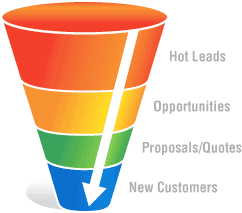
    sales-funnelA sales funnel is a process which can represent your entire sales process in one image. As a funnel is wide at the top and narrow at the bottom, so your sales funnel is meant to call the attention of a wide swath of potential clients in the beginning, and continue to whittle that group down until you reach those who will become paying clients. There are a lot of individual theories related to the sales funnel concept, and there are even tools to help you track your funnel. Here we will take a look at some basics of the sales funnel for an affiliate marketer.

    1. The first step in the sales funnel is broadcasting your marketing message to as many prospects as possible. This does not mean broadcasting to as many people as possible, as all people are not potential customers. For example, if you are advertising to seniors who may want a new walk-in bathtub, you would broadcast your message on seniors’ webpages, in AARP magazine, etc. For affiliate marketers, people usually enter the sales funnel when they enter their information on a landing page, or call in for more information about a product or service.
    2. The second step in the sales funnel will generally differ from business to business, and product to product, but usually includes some kind of customer contact. Here is it important to note that all the steps in the sales funnel are call and response. Now that the customer has given you their information or called your company (step 1), you may respond by replying with an auto responder series, sending them a newsletter, or giving them a free trial. In other words, step 2 is all about responding to the customer’s request for more information.
    3. The third step involves handling the customer’s response to step 2. Depending on the length of the sales funnel this may be the point where the actual sale is made. Other sales funnels will be longer, and may include the customer watching a video, then taking a webinar, then talking to a coach to ask any questions they have, and then finally making the purchase. So, step three and those after really just represent a series of steps the customer will take up to the point of making a purchase. Sometimes the sales funnel will even have a small purchase in earlier steps, leading to a larger purchase in later steps.

    As can be seen, the sales funnel can be as short as 2 steps, or as many steps as the affiliate feels is necessary to convince the prospect that the offer is worth purchasing. In 2013 there were some marketers who disputed the practicality of the sales funnel altogether, saying that prospects are not so readily predictable as to follow the well laid out steps. Considering that a sales funnel is meant to do 2 things: generate sales, and accurately track conversion rates of each step in the process, it is true that any disruption in either of these two metrics could cause the sales funnel concept to falter, but not necessarily fall apart. These would simply be signs that additional tracking metrics are needed, or that some steps of the process need to be improved or eliminated.

  • A Brief Introduction To Affiliate Marketing

    A Brief Introduction To Affiliate Marketing

    In this ever-expanding internet age, one of the most effective ways for companies to increase brand awareness is through affiliate marketing. To put it in the simplest terms, affiliate marketing involves a company “recruiting” other companies or individuals to market their products and services for a commission. Under this definition there are two different forms of affiliate marketing:

    • The first is when a person or business offers an affiliate program to others. The ultimate goal in this kind of marketing is to utilize the power of exponential networking to drive sales leads to the company’s website.
    • The second is when a company or individual signs up as the affiliate for another business. The goal of becoming an affiliate is to capitalize on one’s own ability to drive traffic to the company offering the affiliate program, with the goal of making a sale. Affiliates are then paid a commission for each lead and/or sale they bring to the website.

    Affiliate marketing works differently and more effectively than other kinds of marketing because companies are able to reach untapped markets that the company may not have otherwise been able to draw to their website. Most affiliate programs have come to utilize revenue sharing or pay per sale as a method of compensation. Other methods like pay-per-click were popular in years past but have become obsolete mostly because of various forms of fraud that were involved in their implementation. Most people who participate in affiliate marketing enjoy the work because there is no time or effort investment involved in selling a product. The product already exists so for affiliates it is just a matter of finding creative ways to market that product to a particular market or social or business network.

    For more from CJ.com, click here.