Tag: Social Media

  • What is Cool? Understanding Millennials

    If you happen to follow us on twitter, then you may have seen the article we recently published called “Cracking the Millennial Code“. While this piece was more oriented towards the issues that Millennials face in their attempt to reshape today’s business culture, it failed to address a popular topic of conversation within the marketing industry–namely that of the Millennial as consumer.

    Why is this topic so important in marketing? Because as Pew reports, the Millennial generation is projected to outnumber the Baby Boom generation by the end of this year. Baby Boomers, who have traditionally been the bread and butter of marketing efforts because of their numbers and generally homogeneous consumer behavior, will soon be replaced by a larger, more diverse and technologically driven generation that by all standards has none.

    Who are they?

    This raises some questions about how marketers should respond to this unruly rabble (of which your author is proudly a member). This conversation, however, did not begin with the onset of social media, or the projected exit of the Baby Boomers from the marketplace. In fact, this generation has been on marketer’s minds for some time–particularly how to mold them into predictable consumers.

    Regardless of their overwhelming numbers, extreme diversity and disparate consuming trends, one thing remains constant: we love to consume. I turn to a Frontline report that aired in early 2001, a period that most would look back on as the twilight of our naivete towards the global community that we have become accustomed to through new media. The segment, titled “The Merchants of Cool” explored the ways that marketers addressed and informed the now dubbed “Millennial” generation’s internal discourse over the question, “what is cool?”

    This conversation, along with the increasingly rapid proliferation of personal technology, has come to the post-modern conclusion that “new” and “cool” are synonymous–just look at the queues outside of your local Apple store next time there is a product launch. What is more interesting is the role that social media has played in magnifying the disparities between early adopters of new products or technologies and the general consumer. This constant tension of trying to stay with the curve, and knowing exactly what it takes to do so, has created a generation whose self worth is quantified by their ability to consume (and qualified by an ever attentive global audience).

    A Trend of Consumption 

    This is an activity that has informed a lot of our existence since the beginning. We were born during a period of relative stability and prosperity, and it shows. In fact, at the time of this report to-be-Millennial teens spent an estimated $105 billion dollars, and influenced their parents to spend an additional $49 billion dollars.  Forbes now estimates that this same generation will be spending roughly $200 billion dollars a year (which if we compare to the earlier figures and adjust for inflation shows that the rate of consumption for millennials (in dollars) has not changed since their teens).

    This revelation is interesting, especially when you consider the fact that nominal wage growth has yet to exceed pre-recession levels, let alone that of 2001. What this means is that the millennial generation puts a high premium on their ability to spend money, far above that of financial stability or independence. It should come as no surprise then that 36% of millennials live at home and the same percentage  receive some sort of financial support from their parents.

    This raises two questions. How long will this trend of spending and consumption last, and how can businesses responsibly manage this enormous consumer base? Hopefully with sustained economic recovery the former will resolve itself as more millennials gain employment with sustainable incomes. The latter, however, appears to simply be a matter of being in the right place, at the right time with a new message that speaks to the sensibilities of this highly dynamic generation.



  • The Benefits of a Multi-Pronged Marketing Plan

    Fact: Every business needs customers. That goes undisputed. Generating qualified leads should be in the fore mind of every person working in the digital marketing sphere. This circle continues to expand as traditional marketing disciplines finally shuck their aversion to going all-in with digital services.

    “By 2019, 35% of ad spending will be online. Digital marketing is getting to be a bigger piece of the pie — and that means that traditional marketing and advertising agencies are moving into the digital space in a big way.”

    Moz webinar (4/7/15)

    Photo via Unsplash.com by Todd Quackenbush
    Photo via Unsplash.com by Todd Quackenbush

    Changing of the Guard

    This is so true. Many old-school PR and advertising agencies have struggled to embrace the online marketplace. I remember in the mid-1990’s when most companies thought “this whole having-a-website thing” was a passing fad. Furthermore, popular sentiment back then was businesses that included a URL in their marketing materials or ads were thought to be pandering to a silly trend.

    My, how things have changed! Marketing and advertising are the latest industries to fall prey to the “how-the-heck-do-we-go-digital” trap, but these industries are certainly not alone in their battle to stay relevant.

    Print media (book, magazines, and other periodicals) and entertainment (traditional television, the entire distribution system of both music and film) have struggled with this evolution for the last 20 years, with no end in sight.

    These industries, and many others, have to continually reinvent themselves. The threat of becoming obsolete has proved to be a real one. Trying to compete with the constant barrage of new ideas and platforms is tough. Staunchly holding on to outdated, conventional methods and hoping the “trend” will pass isn’t a recommended strategy.

    So, what are the recommended strategies then? With all the online chatter, what’s the best way to stand out from the crowd? What does a thorough marketing plan really need?

    The Multi-Pronged Approach

    Luckily, the best marketing strategy is a comprehensive one: a plan that includes both modern marketing methods and long-established promotional techniques. There are plenty of ways to spread the word online: SEO, pay-per-call/click,  mobile promotions, link building, social media advertising, PR campaigns, pre-video snippets, native or sponsored content, banner ads… The list goes on.

    The goal is to get your brand or message in front of the right set of eyes. The goal is to target consumers who are already actively interested in your product or service. But this must be done in a natural way.

    We live in a consumer culture. Some people get squeamish when human beings are referred to as “consumers”. But hey – I buy things. I’m a customer, a purchaser, a user of services. I consume, therefore, I’m a consumer. I’m fine with that. It’s far preferable to legislators referring their constituents as “taxpayers”. But I digress.

    Furthermore, I don’t mind being “targeted” when I’m actually on the hunt for something – whether that be granite countertops, red cowboy boots, or a refinance on my mortgage. The objective of any marketing company is bringing together those who provide, and those in need – regardless of specific industry.

    Make your marketing/advertising campaigns count. If you put the needs and desires of people in the forefront of your mind, qualified leads and conversions will follow.

  • Mobilegeddon’s Importance for Marketing Campaigns

    On April 21st Google launched an algorithm change that affects all sites that are not mobile friendly, which has been deemed by many as “Mobilegeddon”. Please remember being mobile doesn’t just mean phones, but all types of tablets are included in this change as well. Since affiliate marketing and online marketing in general is essential for generating leads, if you aren’t up to date on which algorithm changes are pertinent to your site you could suffer a huge loss on your Google search positioning.

    Why This Algorithm is Important

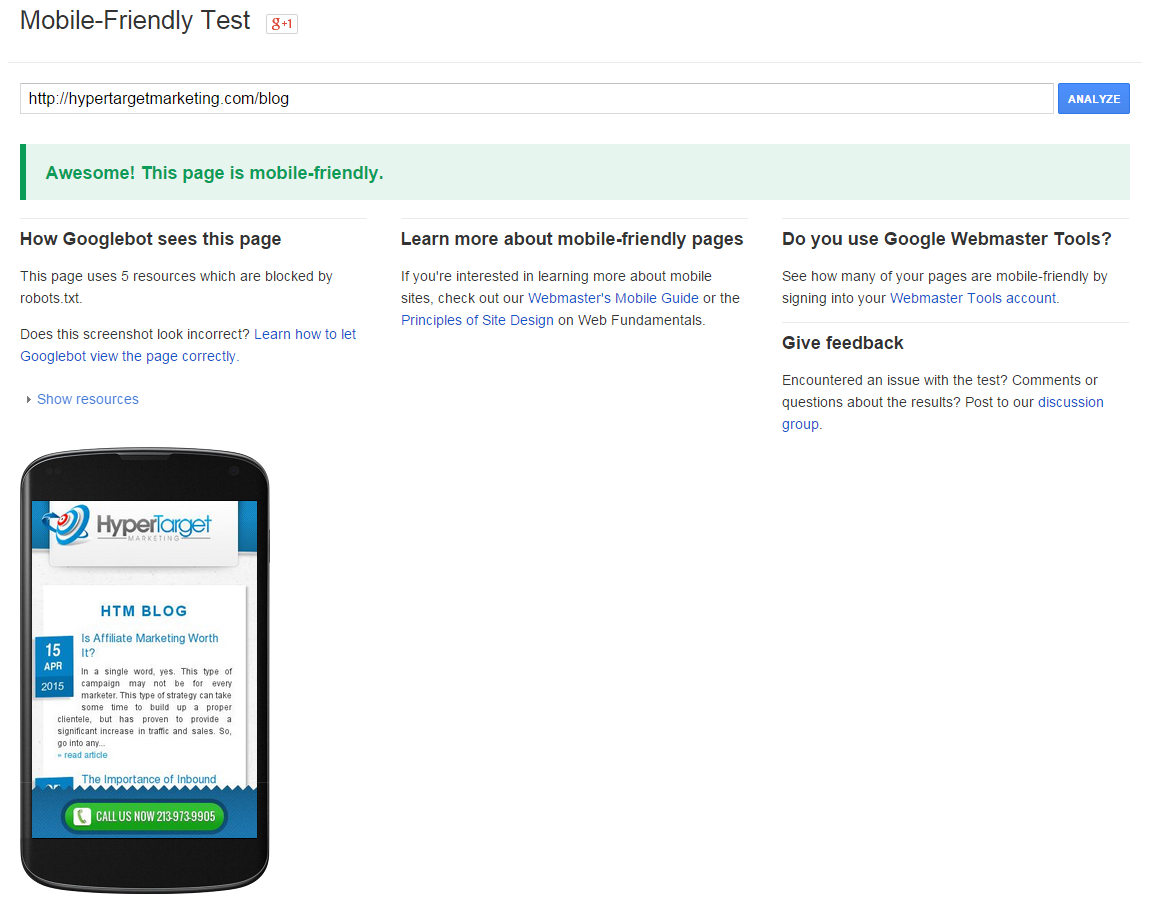
    Google created a “mobile friendly test” that allows users to enter a site URL and check how mobile friendly that site is. On the whole, if your site doesn’t pass the Google test then the Googlebots will see your site as a less reliable source. However, Google did state that if your site is the most relevant option for users that it will still show even if it is not mobile friendly. Sites that are more suitable for all web-linked devices will definitely get a boost in their rankings.

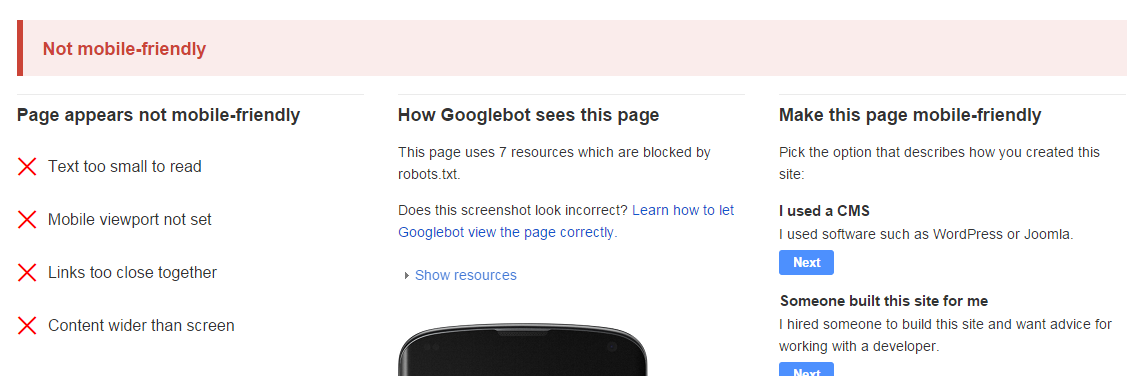
    This tool actually gives a breakdown of all issues that occurred from trying to load that site via mobile. Below we have included a screenshot showing exactly what you will see. The tool shows exactly how Google sees your page and if your site is not mobile friendly it will include a link explaining how to convert your site. It also shows each issue with your site specifically such as small text, page is too wide for mobile, and links are too close together – thus not very clickable, as shown below.

    HTMMobileFriendly


    NotMobileFriendly

    Benefits of Mobile

    Obviously, anyone could explain that social media traffic has greatly increased in the last 5 years alone, which means mobile marketing is importance. It isn’t only effective for the younger populous. Approximately half of the 65+ generation is using social media. This means that having a mobile website isn’t just about gaining the attention of young folks, but also older generations. Your web presence doesn’t have to be “hip” and flashy to be effective, it just needs to be simple and concise for everyone. In fact, an article from Pew Internet & American Life Project says that while young generations are moving away from blogging, more and more senior generations are moving towards blogging. This study also showed that most young adults are moving to “micro-blogging” which mainly consists of much shorter status updates instead of content rich blogging.

    For Your Marketing

    Google’s updates are oftentimes reflective of society. Mobile is important. Users have shown it is important and Google has solidified it. Google algorithm updates are updated to benefit search engine users and can be used as potential sign posts for what users want and how businesses can adapt to these needs. For example, mobile has been emphasized in the most recent update. If you have little to no mobile marketing, now might be the time to adopt a pay per call campaign, MMS (multi-media message service), mobile games and banner ads, or QR bar codes. The Google algorithm is constantly changing to adapt to user needs. Besides rankings and SEO, Google algorithm updates (like “Mobilegeddon”) can have impacts on your business, both positive and negative.