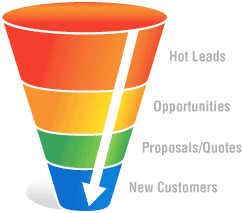
 A sales funnel is a process which can represent your entire sales process in one image. As a funnel is wide at the top and narrow at the bottom, so your sales funnel is meant to call the attention of a wide swath of potential clients in the beginning, and continue to whittle that group down until you reach those who will become paying clients. There are a lot of individual theories related to the sales funnel concept, and there are even tools to help you track your funnel. Here we will take a look at some basics of the sales funnel for an affiliate marketer.
- The first step in the sales funnel is broadcasting your marketing message to as many prospects as possible. This does not mean broadcasting to as many people as possible, as all people are not potential customers. For example, if you are advertising to seniors who may want a new walk-in bathtub, you would broadcast your message on seniors’ webpages, in AARP magazine, etc. For affiliate marketers, people usually enter the sales funnel when they enter their information on a landing page, or call in for more information about a product or service.
- The second step in the sales funnel will generally differ from business to business, and product to product, but usually includes some kind of customer contact. Here is it important to note that all the steps in the sales funnel are call and response. Now that the customer has given you their information or called your company (step 1), you may respond by replying with an auto responder series, sending them a newsletter, or giving them a free trial. In other words, step 2 is all about responding to the customer’s request for more information.
- The third step involves handling the customer’s response to step 2. Depending on the length of the sales funnel this may be the point where the actual sale is made. Other sales funnels will be longer, and may include the customer watching a video, then taking a webinar, then talking to a coach to ask any questions they have, and then finally making the purchase. So, step three and those after really just represent a series of steps the customer will take up to the point of making a purchase. Sometimes the sales funnel will even have a small purchase in earlier steps, leading to a larger purchase in later steps.
As can be seen, the sales funnel can be as short as 2 steps, or as many steps as the affiliate feels is necessary to convince the prospect that the offer is worth purchasing. In 2013 there were some marketers who disputed the practicality of the sales funnel altogether, saying that prospects are not so readily predictable as to follow the well laid out steps. Considering that a sales funnel is meant to do 2 things: generate sales, and accurately track conversion rates of each step in the process, it is true that any disruption in either of these two metrics could cause the sales funnel concept to falter, but not necessarily fall apart. These would simply be signs that additional tracking metrics are needed, or that some steps of the process need to be improved or eliminated.